
REVIEW · BARCELONA GHOST TOURS
Barcelona El Raval Dark History Walking Tour
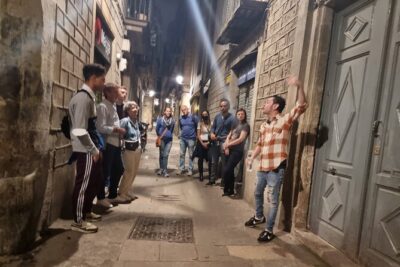
Barcelona has a darker side. The El Raval Dark History Walking Tour shows it in a compact two-hour walk through old hospitals, churches, crime sites, former nightlife districts, and public art spaces. At $33.42 per person, it offers more than a standard orientation walk, especially if you want Barcelona beyond Gaudí and the Gothic Quarter.
I like the small group size, capped at 15 people, and the route’s mix of grim stories, social history, architecture, and present-day street life. I also like that guides such as Eoghan, Zeynep, Callum, Andres, and Cal have earned praise for clear storytelling, humor, and useful local suggestions. The main consideration is the subject matter: stories about murder, abandoned infants, autopsies, and the city’s seedier past may not suit every family or every mood.
Key points to know before booking
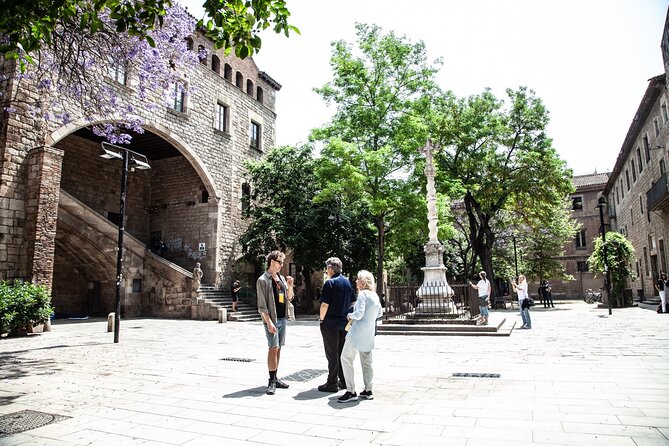
- The route crosses El Raval from Sant Pere Nolasc to the Three Chimneys Gardens, giving you a clear two-hour walk from central Ciutat Vella toward Paral·lel.
- The stories cover more than crime, including medicine, poverty, religion, immigration, nightlife, industrial work, social rights, and street art.
- The group is limited to 15 people, a useful size for hearing the guide and asking questions.
- The Vampire of the Raval story is one of the tour’s central hooks, tied to a real address on Carrer de Joaquín Costa.
- The final stop is especially useful for art lovers, with the Three Chimneys Gardens now known for graffiti.
- The tour costs $33.42, and lunch is not included, though the route ends in an area with plenty of onward options.
Why this walk offers a different Barcelona
Many first visits to Barcelona follow a familiar path: the Sagrada Família, Park Güell, the Gothic Quarter, and perhaps La Rambla. Those places deserve their fame, but they do not explain every side of the city.
This walk takes you through El Raval, a district long tied to hospitals, religious institutions, working-class life, entertainment, migration, crime, and social change. The appeal is not simply that the stories are spooky. It is that the darker material helps explain how Barcelona grew and how certain streets gained their reputation.
I like the balance promised by the route. You are not being led from one sensational crime story to another without context. The stops include a former medical institution, an old church, an industrial site, and a district associated with Chinese immigrants and nightlife. The result should feel closer to a street-level history lesson than a haunted-house performance.
The tone also appears to depend heavily on the guide. Eoghan is repeatedly praised for his warmth, humor, city knowledge, and storytelling. Zeynep and Zaynab are described as informative and helpful, while Callum is praised for keeping a small group involved and offering suggestions for the rest of a Barcelona stay. Guide quality matters on a story-based walk, and this tour seems to place real weight on personality.
More Dark History Tours in Spain
- Barcelona: Dark History Night Walking Tour
★ 4.8 · 344 reviews - Barcelona’s Dark History Night Tour
★ 5.0 · 181 reviews - Barcelona Dark History Night Walking Tour With Drinks
★ 5.0 · 153 reviews
Starting at Sant Pere Nolasc in central Ciutat Vella
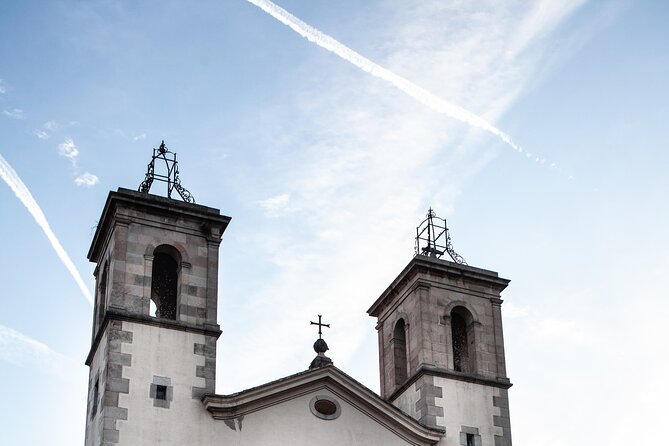
The meeting point is Parròquia de Sant Pere Nolasc Mercedaris at Plaça de Castella, 6. This is a practical starting point in Ciutat Vella, close to public transportation and within the central city area.
The church gives the walk an immediate sense of place. It is not just a random corner chosen for convenience. The opening point introduces the religious and charitable institutions that once shaped daily life in this part of Barcelona.
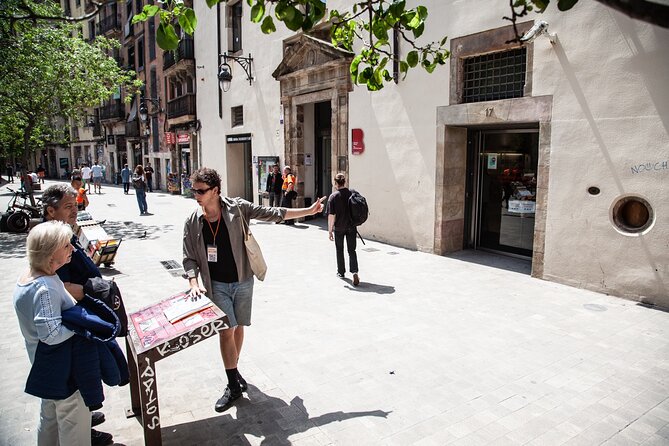
From here, the guide sets up the walk’s main idea: the streets you pass every day can hold stories that are easy to miss. Several people praised the introductions at the beginning, noting that they helped the group relax and made conversation easier. That small detail matters. A two-hour walking tour works better when the guide creates a friendly rhythm early on.
You should arrive ready to walk continuously for about two hours. The tour is not built around long indoor visits, and the admission cost at each listed stop is free. Bring comfortable shoes and expect city streets rather than a formal museum visit.
Stop one: the foundling wheel at Casa de Misericòrdia
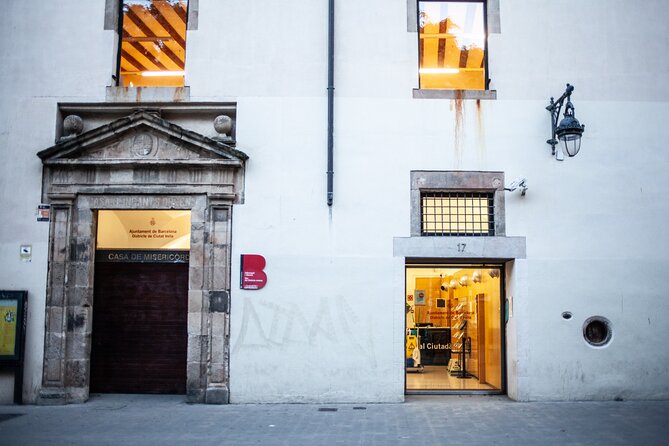
The first major stop is Fundació Privada Casa de Misericòrdia de Barcelona. The subject here is the old foundling wheel, a device used for leaving unwanted infants anonymously.
It is a disturbing story, but it also points toward the harsh conditions faced by poor families and unmarried mothers in earlier Barcelona. The guide can use this site to discuss charity, social rules, religious care, and the limited choices available to vulnerable people.
The phrase hidden in plain sight fits the stop well, since the wheel is not presented as a grand monument. You are looking at an ordinary part of the city with an unsettling past. That is one of the tour’s strengths: the history is attached to doorways and streets, not only to famous buildings.
The stop lasts about 20 minutes. That is long enough for a proper explanation without letting one grim subject dominate the entire walk.
Carrer de Joaquín Costa and the Vampire of the Raval
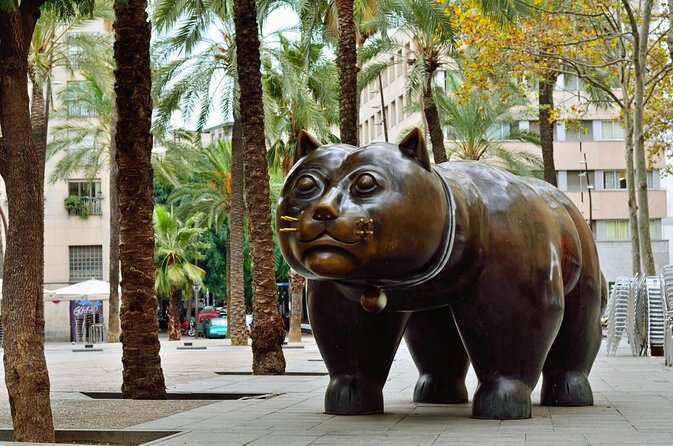
Next comes Carrer de Joaquín Costa, connected with the notorious figure known as the Vampire of the Raval. The tour presents this person as Barcelona’s own Jack the Ripper, giving the walk its most obvious crime-story moment.
This section will appeal to anyone who enjoys true crime and local legends, but the value is broader than the nickname. The story opens a window onto how newspapers, rumors, fear, and public reputation can shape a neighborhood’s identity.
The street itself is part of the experience. You are not hearing a distant tale in a lecture hall. You are standing where the story is connected to the city, surrounded by the ordinary movement of present-day Barcelona. That contrast can be striking.
The material is dark, so I would think carefully before bringing young children. The description focuses on serious crimes, and the tour does not present itself as a light ghost walk. At the same time, the guide’s humor and personable style may keep the tone from becoming relentlessly grim.
More Ghost Walking Tours in Spain
- Barcelona Ghosts of a Dark Past Gothic Walking Tour
★ 5.0 · 55 reviews - Barcelona: El Born Ghost Walking Tour.
★ 4.0 · 54 reviews - Barcelona: El Born Ghost Walking Tour
★ 3.8 · 47 reviews - Barcelona: Ghosts of a Dark Past Walking Tour
★ 5.0 · 10 reviews
The old hospital and Barcelona’s medical past
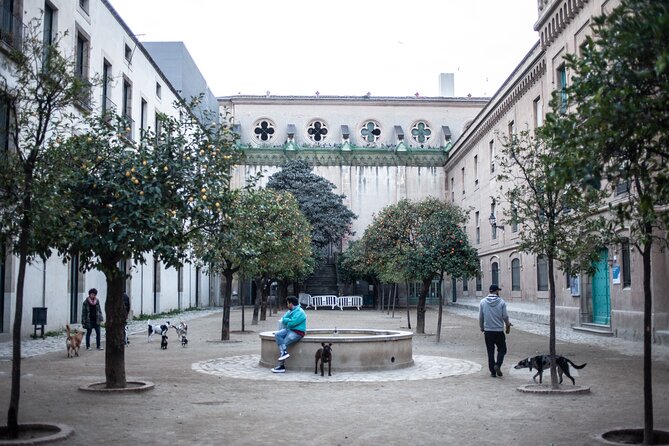
The Real Academia de Medicina de Cataluña occupies part of the former Hospital de la Santa Creu. This stop shifts the focus from crime to medicine, autopsies, and the history of the hospital.
The location is especially useful because it connects medical practice with the urban life of El Raval. Hospitals were not isolated modern facilities. They were part of the neighborhood, tied to religious care, poverty, disease, and the treatment of people who had few other options.
The reference to autopsies gives this section its macabre edge. You can expect an explanation of why the former hospital became associated with such work and how medical institutions functioned in earlier periods. The stop adds substance to the walk, showing that Barcelona’s darker past includes the history of science and public health, not just notorious criminals.
This is also one of the places where a good guide can make a major difference. A clear explanation can turn a grim detail into a useful lesson about the city. A rushed explanation would leave you with little more than a spooky anecdote.
Sant Pau del Camp and a violent monastic past
Sant Pau del Camp is described as Barcelona’s oldest church. It was previously a monastery, and the tour focuses on its violent history.
The church adds architectural and religious depth to the route. If you have already seen Barcelona’s grand basilicas, this stop offers a different scale and mood. The building’s age and former monastic role give the guide plenty of room to explain how religious communities fit into the city’s development.
The darker material keeps the stop in line with the tour’s theme. Monasteries are often presented as quiet, peaceful places, but their stories can also include conflict, power struggles, and violence. That contrast is part of what makes this walk more interesting than a simple list of old buildings.
You should not expect an extended interior visit based on the information provided. The church is one of six principal stops, each allocated about 20 minutes, so the emphasis is on the guide’s explanation and the setting around you.
Avenida del Paralelo and the old Chinese district
The route then moves toward Avenida del Paralelo, once associated with Barcelona’s Chinese district and with the city’s seedier 20th-century nightlife.
This section broadens the tour again. It is not only about murder or haunted buildings. It introduces migration, entertainment, social divisions, and the changing character of a major avenue.
The reference to the Chinese district gives you a chance to consider the people and businesses that shaped this part of Barcelona. The nightlife connection adds another layer, since Paral·lel was linked with theaters, clubs, and less respectable forms of entertainment. The guide’s job here is to show how the district changed over time, rather than treating its past as a collection of colorful labels.
This stop may be especially useful if you plan to spend more time around Paral·lel later. You will arrive with some context for the streets, venues, and neighborhoods around the avenue. Several guides have also been praised for offering restaurant and sightseeing tips, so this is a good point to ask about what to do after the walk.
Finishing at the Three Chimneys Gardens
The final stop is Jardins de les Tres Xemeneies, or the Three Chimneys Gardens, at Avenida del Paral·lel, 49. The route ends here rather than returning you to the starting point.
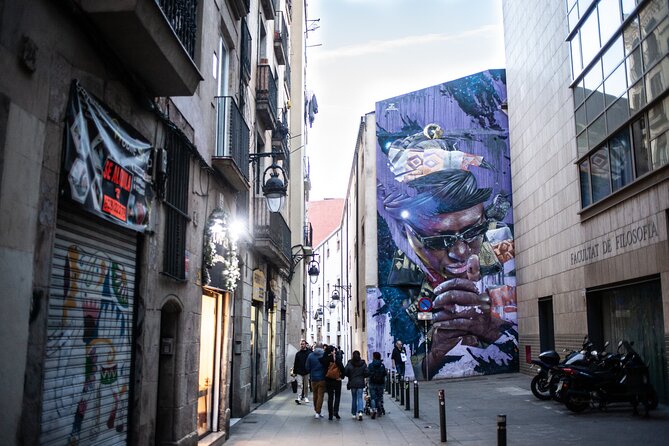
The gardens occupy a former industrial area and are now known for graffiti art. This is a smart finish. After two hours of churches, crime, medicine, and old nightlife, the route ends with a visible sign of modern Barcelona.
For street-art fans, the stop may be a highlight. The public art gives you something to look at and photograph, while the former industrial setting shows how urban spaces can change use over time. The ending also connects the city’s working past with its current creative life.
Plan your onward route before you start. The walk begins at Plaça de Castella and ends at the Three Chimneys Gardens, so you will not finish where you began. That is not a problem, but it is worth knowing if you have a dinner reservation or another timed activity near the starting point.
What $33.42 gets you
At $33.42, this is not the cheapest way to spend two hours in Barcelona. You can walk through El Raval on your own for free. The question is what you gain by paying.
The answer is structure and interpretation. Without a guide, you might pass the old hospital, Sant Pau del Camp, or the Three Chimneys Gardens without understanding how they connect to crime, medicine, religion, migration, nightlife, and industry. The tour gives those places a narrative.
The group limit of 15 also supports the price. You are not being placed in a huge crowd where the guide becomes hard to hear. A small group makes it easier to ask about food, art, safety, transport, or other parts of the city.
Lunch is not included, but that is reasonable for a two-hour walk. The end point around Paral·lel gives you a useful base for making your own next plan. Guides have been praised for suggesting places to eat, which adds practical value if you treat the tour as part of your first day in Barcelona.
Who should book this walk?
I would choose this tour if you have already seen the main monuments, or if you want a first introduction that shows Barcelona’s less polished side.
It is a good match for:
- Adults interested in crime, medicine, old institutions, and urban legends
- Visitors who enjoy local stories more than standard sightseeing commentary
- People who want to understand El Raval before exploring it alone
- Street-art fans who like ending at the Three Chimneys Gardens
- Small groups who value a personal guide and the chance to ask questions
- First-time visitors who want practical food and neighborhood suggestions
I would be more cautious if you dislike graphic subjects or want a relaxed architecture walk. The tour’s themes include unwanted infants, violent crime, autopsies, and seedy nightlife. The guide can make the experience friendly, but the subject matter remains serious.
The area’s reputation may also make some people uneasy. One useful feature of the tour is that a guide can place the neighborhood in context and help you feel more at ease. Still, you should stay aware of your surroundings, as you would anywhere in a busy European city.
Timing, group size, and practical details
The advertised duration is approximately two hours. Each of the six listed stops is allocated about 20 minutes, creating a steady pattern of walking followed by focused storytelling.
The maximum group size is 15. That is small enough for direct contact with the guide, but it is not a private tour. If you want a fully personal experience, this will not provide that.
Your mobile ticket is confirmed at booking. Service animals are allowed, the start point is near public transportation, and most people can take part. The tour does not list lunch as included.
Free cancellation is available if you cancel at least 24 hours before the start time. Changes or cancellations inside that window are not accepted for a refund. The activity also requires a minimum number of participants, and if that minimum is not met, you are offered another date or experience, or a full refund.
Should you book the El Raval Dark History Walking Tour?
Book it if you want Barcelona with the polished surface removed. The strongest parts are the clear route, the mix of social and criminal history, the small group, and the guides’ warm storytelling style.
I would especially recommend taking it near the beginning of your stay. The walk can give you a better sense of El Raval, Paral·lel, and the Three Chimneys area, while the food and neighborhood tips may help shape the rest of your visit.
Skip it if you want a cheerful Gaudí-focused outing, a museum-heavy tour, or a gentle family walk with no grim subjects. For everyone else, $33.42 is a fair price for two hours of context you are unlikely to get from simply following a city map.
FAQ
How long is the Barcelona El Raval Dark History Walking Tour?
The tour lasts approximately two hours.
How much does the tour cost?
The listed price is $33.42 per person.
How many people can join the tour?
The tour has a maximum of 15 participants.
Where does the tour begin?
It begins at Parròquia de Sant Pere Nolasc Mercedaris, Plaça de Castella, 6, in Barcelona’s Ciutat Vella.
Where does the tour end?
It ends at Plaça de Les Tres Xemeneies, Avenida del Paral·lel, 49, at the Three Chimneys Gardens.
Is lunch included?
No. Lunch is not included in the tour price.
Is the tour available with a mobile ticket?
Yes. A mobile ticket is available, and confirmation is received at the time of booking.
Can I cancel for a full refund?
Yes, if you cancel at least 24 hours before the experience start time. Cancellations made less than 24 hours in advance are not refunded.
More Ghost Walking Tours in Barcelona
- Walking Tour Mysteries and Legends of Barcelona and its Ghosts
★ 5.0 · 3 reviews - New Orleans Premier Ghost, Voodoo and Vampire Walking Tour
★ 4.5 · 12,856 reviews - London: The Original Jack the Ripper Walking Tour
★ 4.7 · 7,833 reviews - Chicago: Gangsters and Ghosts Walking Tour
★ 5.0 · 7,155 reviews
More Dark History Tours in Barcelona
- Barcelona: Gothic Quarter Tour Dark History & Ghosts Tour
★ 4.8 · 64 reviews - Barcelona’s Dark History Walking Tour in El Raval
★ 4.8 · 6 reviews - Dark History and Legends Night Walk of Gothic Quarter
★ 5.0 · 2 reviews - Adults-Only New Orleans Ghost, Crime, Voodoo, and Vampire Tour
★ 5.0 · 6,545 reviews
Newly added around Barcelona
- Walking Tour Mysteries and Legends of Barcelona and its Ghosts★ 5.0 · 3 reviews
- Witch Hunt on Montjuïc: Self-Guided Puzzle Quest in Barcelona★ 4.5 · 9 reviews
- Barcelona Ghosts of a Dark Past Gothic Walking Tour★ 5.0 · 55 reviews
- The Gothic Trail – Ghosts of Barcelona Exploration Game★ 4.5 · 33 reviews
- Dark History and Legends Night Walk of Gothic Quarter★ 5.0 · 2 reviews
- Barcelona Ghosts and Legends Gothic Quarter Tour★ 5.0 · 152 reviews
- Barcelona: El Born Ghost Walking Tour.★ 4.0 · 54 reviews
- Barcelona: El Born Ghost Walking Tour★ 3.8 · 47 reviews
Barcelona Ghost Tours, compared.

Barcelona Dark History Night Walking Tour With Drinks
Read our review →
Barcelona Ghosts and Legends Gothic Quarter Tour
Read our review →
Barcelona Ghosts of a Dark Past Gothic Walking Tour
Read our review →
Browse the lists this tour appears in