
REVIEW · WITCH TRIAL & WITCHCRAFT TOURS
Bewitched with our tour to Queretaro
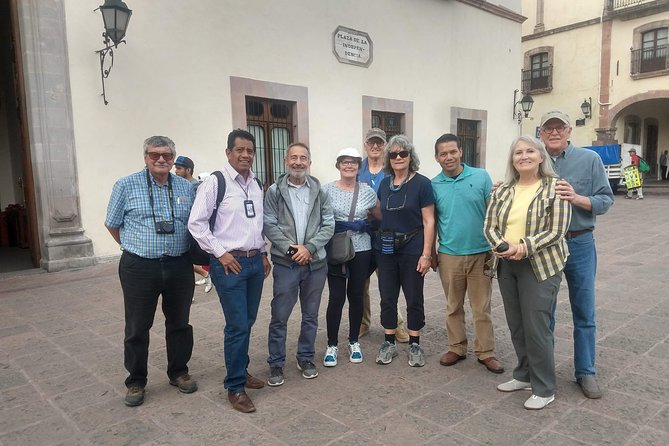
Querétaro rewards a closer look. This full-day trip from San Miguel de Allende packs colonial churches, independence-era sites, a museum, and the city’s famous aqueduct into one guided outing. I like the small-group limit of 10 people and the fact that hotel pickup and transfers are included, which saves you from arranging a long day of transport yourself. I also like the range of stops, from the Hill of the Bells to the old convent of Santa Cruz.
The main drawback is the schedule. You have many short visits, and several churches receive only 15 minutes. Pickup details also deserve care: one recorded problem involved a passenger waiting in the wrong city after a location mix-up. Confirm that your pickup is in San Miguel de Allende before departure.
Key points before you book
- A full day from San Miguel de Allende: The tour begins at 9:00 a.m. and returns to the same meeting point, with the outing lasting about eight hours and often running close to 5:00 p.m.
- The aqueduct is a highlight: You drive alongside all 1,280 meters of this 18th-century structure, including its 74 arches.
- History comes through people and places: Josefa Ortiz de Domínguez, Emperor Maximilian, Don Antonio de Urrutia y Arana, and Miguel Cabrera all connect to the day’s stops.
- Guide quality matters: J. Jesus Rodriguez has been praised for his friendly manner, clear explanations, flexibility, and local knowledge.
- Lunch is on you: The price covers pickup and a guide, but not your midday meal.
- Confirm the meeting point: Departure is from Relox 84 in San Miguel de Allende, not from Querétaro.
Why Querétaro makes a good day trip

Querétaro is a useful counterpoint to San Miguel de Allende. Both cities offer Spanish colonial buildings and old churches, but this excursion gives you a wider historical frame. You move from Indigenous foundation stories and Franciscan evangelization to the Mexican independence movement, viceregal art, and 18th-century engineering.
At $120 per person, the value comes mainly from the included transportation and guiding. You do not need to rent a car, work out the route, or find each monument on your own. That matters on a day with stops spread across the city and its outskirts.
The price is less attractive if you prefer slow, independent sightseeing. Several visits are brief, and you will not have unlimited time for cafés, shopping, or a leisurely lunch. I would see this as a practical introduction to Querétaro rather than a relaxed city stay.
The group is capped at 10 people, which should make it easier to hear the guide and ask questions. The English-language service is useful if you do not speak Spanish. The guide can give the buildings context that is easy to miss when you simply walk past their façades.
More Witch Tours in the world:
- Edinburgh: Witches & Haunted History Walking Tour
★ 4.8 · 1,290 reviews - Wicked Awesome Tours: Witch Trial History and Salem Haunts!
★ 5.0 · 1,032 reviews - Edinburgh: Witches & Haunted History Walking Tour
★ 5.0 · 632 reviews
Starting at the Hill of the Bells
The first stop is the Hill of the Bells, a historical site on the edge of the city. The unusual name is part of the visit, and your guide explains the local story behind it.
The hill also connects to Emperor Maximilian of Habsburg, who was shot here. That gives the stop a serious historical weight, even though the visit lasts only about 30 minutes. It is a good opening because you begin outside the central streets and hear about a dramatic episode before moving into Querétaro’s churches and civic buildings.
Admission is included. Since this is an outdoor historical site, you may want comfortable shoes and protection from the sun, though the tour information does not specify the exact conditions on the day.
Baroque detail inside Santa Clara
The Church of the Sacred Heart of Jesus, also known as the Santa Clara Temple, occupies a former convent founded in 1607 by Diego de Tapia, the son of one of Querétaro’s founders. The building is presented as one of the city’s strongest examples of baroque design.
You have about 15 minutes here, so use your time well. Look upward and toward the altarpieces, which are covered with gold leaf. The stop is short, but the interior decoration gives you a quick sense of the wealth and religious art that shaped colonial Querétaro.
There is no admission charge. The limited time is the obvious tradeoff. If ornate church interiors are your main interest, you may wish for longer here, but the tight schedule allows the tour to cover much more of the city.
Jardin Zenea and the center of Querétaro
Jardin Zenea is a green central square with fountains and a kiosk dating from the early 1900s. It is named for José Santos Zenea, a governor of the state who was well regarded locally.
You spend about 15 minutes here. That is enough to get your bearings and see how the square fits into the city center, but not enough for a long sit or a close look at every surrounding building. I like this stop because it breaks up the church visits and gives you a public space where daily city life continues around the monuments.
The square also helps you understand Querétaro’s layout. From here, the tour moves through the historic core, where grand houses, churches, government buildings, and restaurants sit close together.
Same streets, an entirely different kind of scare:
- New Orleans Premier Ghost, Voodoo and Vampire Walking Tour
★ 4.5 · 12,856 reviews - The World Famous Underground Ghost Tour
★ 4.5 · 9,272 reviews - Chicago: Gangsters and Ghosts Walking Tour
★ 5.0 · 7,155 reviews - Edinburgh: Haunted Underground Vaults and Graveyard Tour
★ 4.6 · 6,607 reviews
Regional Museum in a former Franciscan convent
The Regional Museum occupies the former Convent of San Francisco, a 16th-century building noted for its viceregal architecture. This is the longest indoor stop, with about 40 minutes to see the collection.
That extra time matters. Museums can feel rushed on a day tour, but 40 minutes gives you a reasonable chance to view the main rooms and exhibits. The building itself is part of the experience, so pay attention to the convent structure as well as the objects displayed inside.
Admission is included. If you enjoy art, religious history, or old buildings, this is likely one of the strongest stops. If museums are not your priority, the guide’s explanation can still help connect the objects to the churches and civic sites you see later.
Casa de la Corregidora and the independence story
The Palacio de Gobierno, also called Casa de la Corregidora, is one of the day’s essential historical stops. It now functions as the governor’s palace, but its importance reaches back to 1810.
Josefa Ortiz de Domínguez was imprisoned here. From this building, she sent a message to Captain Allende that helped make the insurgent movement against the Spanish Crown possible. The story gives the building a direct link to Mexican independence, rather than leaving the subject as a distant date in a textbook.
You have about 20 minutes, and admission is free. This is a place where a good guide adds real value. J. Jesus Rodriguez has been praised for making the history informative and entertaining, and this stop gives him a strong setting for telling the story.
Plaza de Armas and the aqueduct connection
Plaza de Armas is Querétaro’s main square, framed by baroque houses and restaurants. In the center is a monument to Don Antonio de Urrutia y Arana, the marquis who financed the city’s aqueduct.
The square receives only 15 minutes, but it is an important link between the city’s architecture and its water system. Look at the surrounding façades and the scale of the public space before the group moves on.
This is also one of the spots where you may wish for free time. The tour is designed to show you the square and explain its meaning, not to give you a long restaurant break. Since lunch is not included, ask the guide how the day’s timing will work before you set off.
The Guadalupe sanctuary and its colonial art
The Sanctuary of the Congregation of Our Lady of Guadalupe was built in 1680. Its façade, altarpieces, paintings, and pipe organ make it one of the more visually detailed churches on the route.
The sanctuary also holds a painting of Our Lady of Guadalupe by Miguel Cabrera, a well-known colonial master. That single work gives the visit special importance for anyone interested in Mexican religious art.
Again, the scheduled time is about 15 minutes. You will need to look quickly, but the guide can point out the most important features. This is a stop where a little preparation helps: keep your attention on the altar, paintings, organ, and façade rather than trying to inspect every detail.
Driving beneath the 74 arches
The Querétaro aqueduct is the city’s great engineering symbol. Built from 1726 to 1738 by Don Juan Antonio de Urrutia, it stretches 1,280 meters and has 74 arches. The tallest arch reaches 28 meters.
The tour drives along the full length of the aqueduct, from side to side. That is different from a quick photo stop. You get a sense of its scale and how the structure defines the city’s visual identity.
Because you see the aqueduct from the vehicle, your view depends on the route and traffic. Still, this is one of the most efficient parts of the day. You cover a large structure without adding another long walking segment, and the drive gives your feet a break after the central-city stops.
Santa Cruz and the founding story
The final listed stop is the Temple and Former Convent of Santa Cruz de los Milagros. Tradition places the foundation of Querétaro on El Sangremal Hill, where the city was established on July 25, 1531.
The convent is tied to Franciscan evangelization. You can stroll through its patios and corridors, which offer a change from the grand public squares and decorated church interiors. A distinctive feature is the tree said to produce cross-shaped thorns, a detail that adds a memorable local story to the visit.
The scheduled time is about 30 minutes. Admission is not included, so keep a little cash available for this stop. The information does not state the admission price, so you should not count on a fixed amount.
Transport, timing, and the small-group setup
The experience begins at 9:00 a.m. at Relox 84, Zona Centro, San Miguel de Allende, and ends back at the same meeting point. Pickup is included, but the published details identify the meeting point rather than a list of individual hotels. Confirm your exact pickup instructions before the day begins.
The tour is described as lasting about eight hours. One account places the day roughly from 9:00 a.m. to 5:00 p.m., so plan your schedule as a full day rather than assuming you will be back soon after lunch.
A maximum of 10 people is a useful limit. It should be easier to hear explanations, stay together at busy sites, and ask for clarification than it would be in a large coach group. The guide and driver are separate roles on at least some departures, and J. Jesus Rodriguez has received particular praise for being friendly, flexible, amusing, and attentive.
There was also one serious pickup failure connected to confusion over the departure city. The operator apologized and offered a refund, but you should treat this as a reason to verify the basics: San Miguel de Allende is the starting point, Querétaro is the destination, and the return is to the original meeting point.
What the $120 price really covers
The $120 fee includes pickup and a tour guide. It also covers admission to the Hill of the Bells and the Regional Museum. Entry to Santa Cruz is not included, and lunch is not included.
For you, the strongest value is convenience. Querétaro is far enough from San Miguel de Allende that private transport can add cost and planning work. A guide also ties together sites that might otherwise feel scattered.
The weaker value is the limited personal time. You are paying for an organized overview, not a slow food-and-architecture day. If you want to sit in Jardin Zenea, linger in the museum, or compare every church interior, you may find the pace too brisk.
Free cancellation is available if you cancel at least 24 hours before the start time. Changes or cancellations made inside that window are not accepted for a refund, and the tour requires a minimum number of participants. If the minimum is not met, you are offered another date or experience, or a full refund.
Who should book this Querétaro tour
I would recommend it to you if San Miguel de Allende is your base and you want a guided first look at Querétaro without renting a car. It is especially suitable if colonial architecture, Mexican independence, churches, museums, and local stories all interest you.
It also suits you if you prefer structure. The route is organized, the group is small, and the guide handles the transfers. English is offered, and most people can participate according to the published information.
I would hesitate if you want a leisurely city day, a long lunch, or several hours of independent wandering. The tour covers a lot, but that means some stops are quick. You should also confirm pickup details carefully because the departure city is central to the whole plan.
FAQ
Where does the tour begin?
The tour begins at Relox 84, Zona Centro, 37700 San Miguel de Allende, Guanajuato, Mexico.
What time does the tour start?
The scheduled start time is 9:00 a.m.
Where does the tour end?
The activity ends back at the original meeting point in San Miguel de Allende.
How long does the tour last?
The tour lasts approximately eight hours. An account of the day places the timing at about 9:00 a.m. to 5:00 p.m.
Is hotel pickup included?
Pickup is included. You should confirm the exact pickup details because the listed meeting point is in San Miguel de Allende.
Is lunch included?
No. Lunch is not included in the tour price.
Is the tour offered in English?
Yes. The experience is offered in English.
How many people can join the tour?
The maximum group size is 10 people.
Are entrance fees included?
Admission to the Hill of the Bells and the Regional Museum is included. Santa Cruz has an admission charge that is not included. The other listed stops have free admission.
Can I cancel for a refund?
Yes. You can cancel at least 24 hours before the start time for a full refund. Cancellations made less than 24 hours before the start time are not refunded.
Should you book it?
Book this tour if you want an efficient, history-focused day from San Miguel de Allende, with transport, a small group, and a guide who can connect Querétaro’s churches, independence sites, museum, and aqueduct. The strongest parts are the range of places and the personal attention possible in a group of 10 or fewer.
Skip it if you want to set your own pace. Before paying, confirm that your pickup is in San Miguel de Allende, set aside money for lunch and the Santa Cruz admission fee, and plan for a full day. With those details clear, the tour offers a useful and well-packed introduction to Querétaro.
Newly added around the world
- Zion: Harry Potter-Inspired Zion Ghost Tour with Sunset View★ 5.0 · 8 reviews
- York : Private Ghost Hunt★ 5.0 · 3 reviews
- Your evening in Venice – Legends&Ghosts&Aperitif★ 4.7 · 79 reviews
- York’s Haunted Heart : Ghost, Ghouls and Gallows★ 4.6 · 82 reviews
- Witches, Widows, & Wraiths: Wichita Ghost Tours★ 5.0 · 2 reviews
- Wraiths of the West Texas Wind: El Paso Ghost Tour★ 4.5 · 9 reviews
- Witches, ghosts and executioners / Mystical North Hesse★ 4.4 · 4 reviews
- Wraiths & Wicked Whispers: Wilmington Ghost Tour★ 4.2 · 25 reviews
Witch Trial & Witchcraft Tours, compared.


Wicked Awesome Tours: Witch Trial History and Salem Haunts!
Read our review →
Best Salem Witch Trials Historical Walking Tour
Read our review →
Browse the lists this tour appears in