
REVIEW · GERMANY GHOST TOURS
Witch Trials in Bamberg
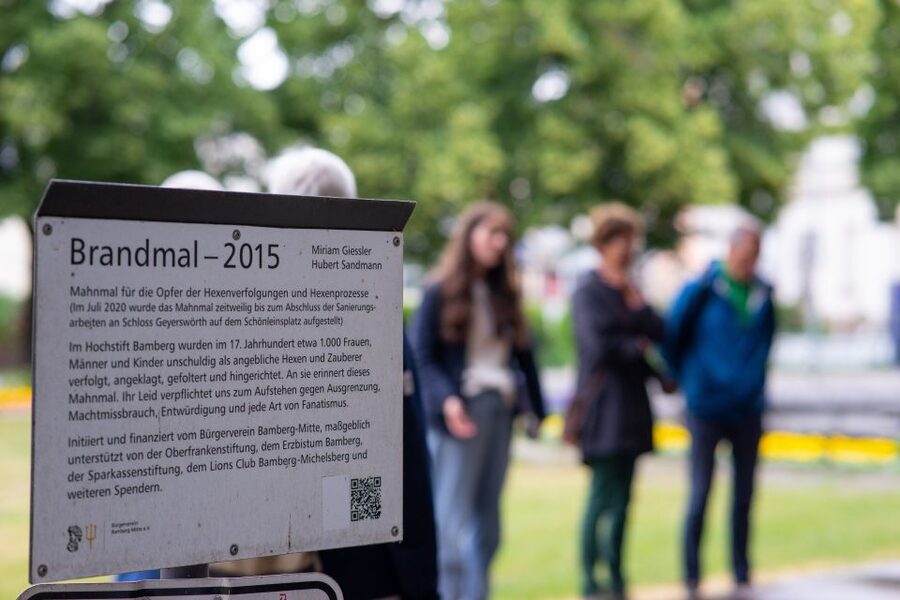
Dark stories fit Bamberg’s old lanes. This 1.5-hour walking tour connects the city’s handsome old center with the grim story of 17th-century witch trials, when hundreds of people were accused, imprisoned, and killed. I like the focus on ordinary people from all levels of society, and I like the visit to the medieval Lochgefängnisse, or prison cells. The tour is not just about spooky tales. It explains how fear, politics, and local beliefs shaped Bamberg.
I also like the way the walk links the witch hunts to Bamberg’s wider past, including the Old Court, Geyerswörth Palace, and the former Malefiz-Haus. The main drawback is simple: the tour is offered in German only. You will also be outside for most of the 90 minutes, so cold weather can make the experience less comfortable, though recent feedback praises the guide for keeping the walk clear and interesting even in chilly conditions.
Key points to know before you book

- The story reaches beyond the usual witch-hunt clichés: Men, women, citizens from different social classes, and even Bamberg mayors could be accused.
- The medieval Lochgefängnisse add a physical sense of the past: These prison spaces help explain what happened after an accusation.
- The walk begins at Domplatz: Meet in front of the Alte Hofhaltung entrance, by the Schöne Pforte.
- Geyerswörth Palace is one of several historic settings: The tour uses Bamberg’s old streets and buildings to frame the story.
- The tour ends near the former Malefiz-Haus: This location operated from about 1627 to 1650 and gives the walk a suitably serious final stop.
- German is the only listed language: You receive a live guided tour from Geschichte Für Alle e.V.
A dark subject in a beautiful old town
Bamberg is an easy city to admire. Its old center has narrow lanes, grand buildings, and attractive squares. This tour asks you to look past the pleasant façades and consider the fear that shaped daily life in the 17th century.
The witch trials were not a small side story. Hundreds of Bamberg citizens became victims of the persecution. The accusations did not target only elderly women or people with unusual appearances. Men were accused too. So were people from different parts of society, including mayors.
That point matters. It keeps the tour from becoming a collection of familiar myths. Instead, you get a picture of a community where suspicion could reach almost anyone. A person accused of witchcraft could lose freedom, reputation, and life.
I appreciate that the tour treats this as a history of power and social fear rather than a spooky costume show. The subject is dark, but the guide’s job is to explain how people at the time understood the world and why accusations gained force.
More Witch Tours in Germany
- Munich: Witches and Executioners Guided Tour
★ 4.7 · 353 reviews - Oldenburg: “Executioners, witches & scoundrels” (crime thriller tour)
★ 4.6 · 50 reviews - Freiburg: Acting tour “Witches, Torture, Stake” with Historix-Tours
★ 4.7 · 42 reviews
Meeting at the Schöne Pforte on Domplatz
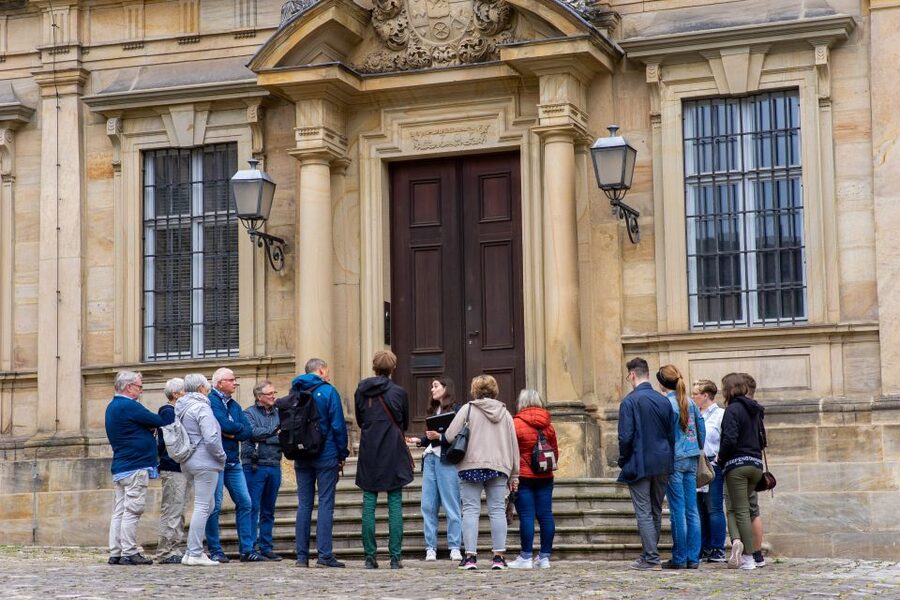
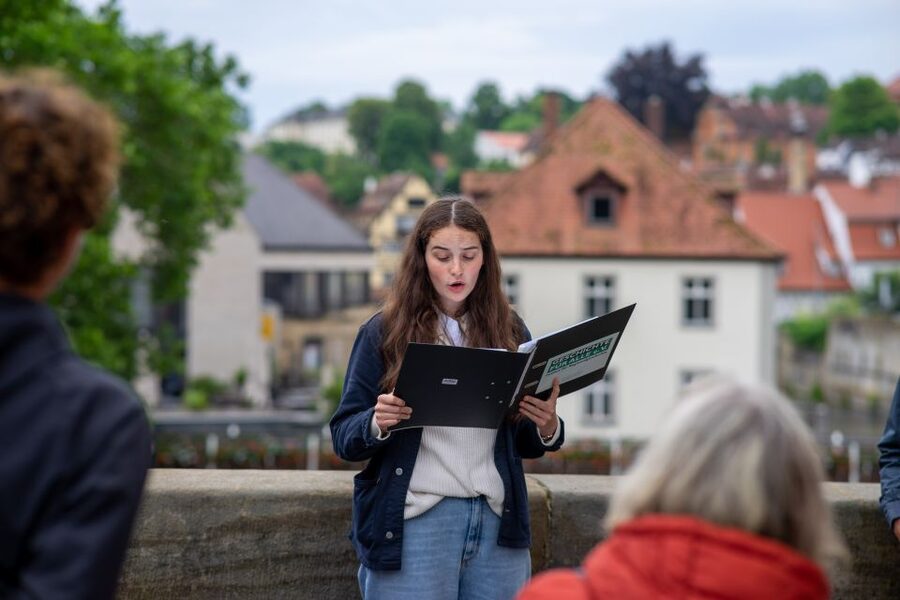
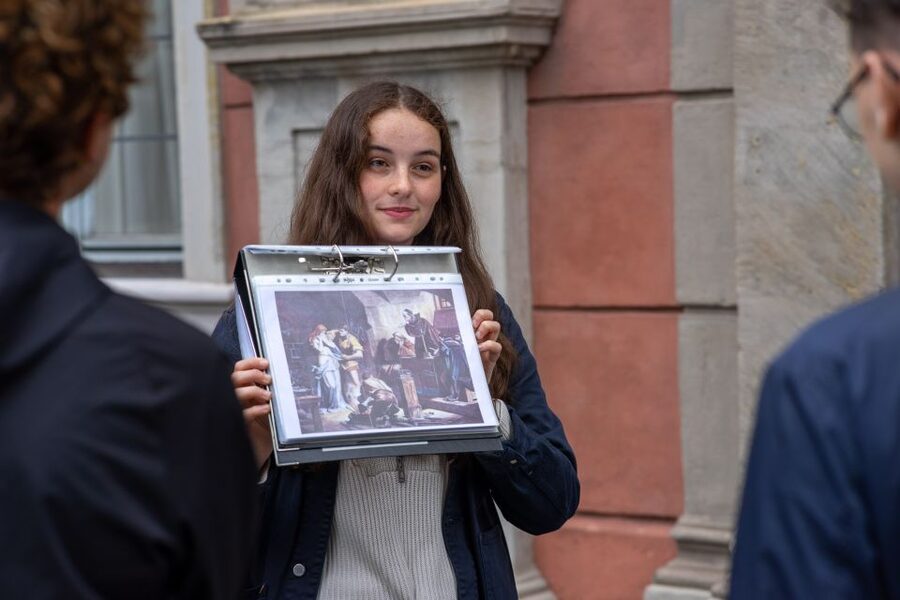
Your meeting point is on Bamberg’s cathedral square, or Domplatz, in front of the entrance to the Alte Hofhaltung. The guide carries a picture folder and wears a name badge marked Geschichte Für Alle e.V., making the group easy to identify.
The nearby Schöne Pforte is a useful starting point because it places you right in the historic core. You do not begin at a distant transport stop or spend the first part of the tour getting into town. The first steps take you through the old center, where the setting itself helps establish the period under discussion.
Give yourself enough time to find the entrance to the Alte Hofhaltung. Domplatz is a well-known part of Bamberg, but historic squares can have several nearby entrances and sight lines. Arriving a little early also gives you time to orient yourself before the guide begins.
The group then moves through the Old Court, or Alte Hofhaltung. This is one of the tour’s important stops, but the value is not simply the building itself. The guide uses Bamberg’s political and civic spaces to show how the city functioned during the period of the witch hunts.
You will hear about the persecution in a place tied to the city’s older authority. That setting helps connect individual accusations with institutions, officials, and decisions. The tour is stronger when you think of the trials as part of public life, not as isolated incidents in distant villages.
The Old Court and the city behind the accusations
The Old Court gives the walk a firm historical foundation. Here, the subject shifts from general ideas about witch hunts to Bamberg’s own experience.
You can expect the guide to explain the scale of the persecution and the kinds of people caught up in it. The supplied information does not promise a specific room-by-room visit or a museum exhibit, so think of this as a guided outdoor stop rather than a long interior tour.
That distinction is useful when planning. You are paying for interpretation and local context, not a full day of admissions. The guide’s picture folder can support the storytelling, giving the group visual help while standing in places that may have changed over time.
The tour also places Bamberg within a larger regional story by discussing the history of witch hunts in Nuremberg. That comparison gives you a broader view without taking you away from Bamberg. You learn that the pattern was not confined to one city, while the walk remains rooted in the streets around you.
One of the most praised parts of the experience is the explanation of how people thought at the time. The German comments from recent participants describe the tour as informative, engaging, and especially good at explaining contemporary life and ways of thinking. That is exactly the context you want from a difficult historical subject.
Short walks through Bamberg’s old alleys
The route is broken into several short walks. One section takes about five minutes, another about four minutes, then later stretches take around two, five, and six minutes.
That pacing should suit you if you prefer a tour with regular stops rather than a long lecture in one place. You move through the old town, pause for explanation, then continue to the next setting. The walks are short enough to keep the focus on the story.
At the same time, this is still a walking tour. The route uses old alleys and historic streets, so comfortable shoes are sensible. The activity is listed as wheelchair accessible, but the information provided does not describe the surface of every lane or the exact access arrangements at each stop. If you use a wheelchair, confirm the route details with the provider before booking.
The short distances also make this a practical choice for fitting into a day of sightseeing. At 90 minutes, it does not take over your schedule. You can place it before or after other visits in Bamberg, though the subject may leave you wanting a quieter pause afterward.
Same streets, an entirely different kind of scare:
- Munich Ghosts and Spirits Evening Walking Tour
★ 5.0 · 1,900 reviews - Gruseltour Leipzig: A Haunted Guided Tour
★ 4.5 · 1,385 reviews - Munich: Spooky Tour of Old Town in German
★ 4.6 · 1,112 reviews - Stuttgart: Guided Ghost Walking Tour
★ 4.5 · 867 reviews
Geyerswörth Palace and the wider civic story
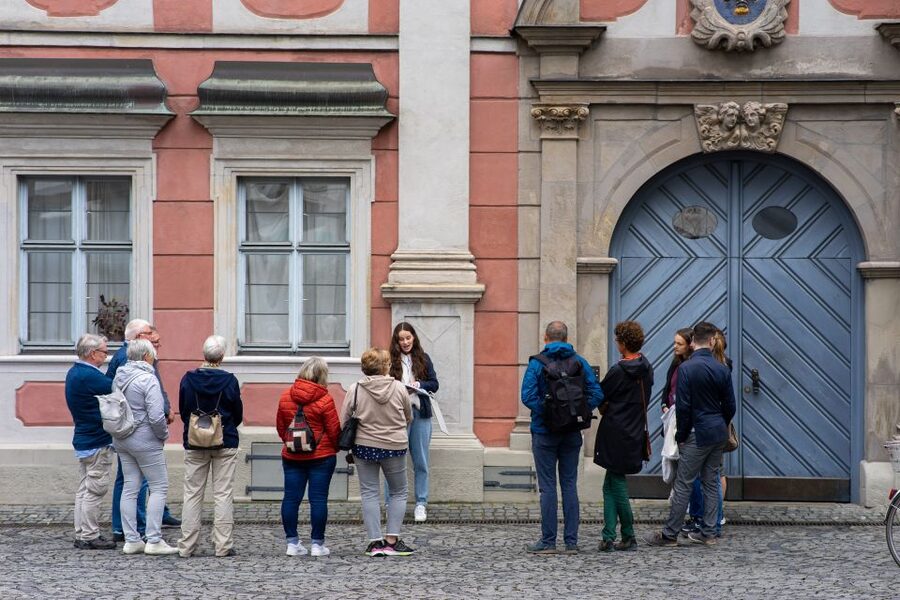
Geyerswörth Palace is another major stop. The tour does not treat the palace as an unrelated photo opportunity. It forms part of the walk’s effort to connect Bamberg’s buildings with the people and institutions involved in its past.
This kind of setting is useful because it shows how history is spread across a city. The witch trials did not happen in a single building that tells the whole story. Decisions, accusations, imprisonment, and public fear were tied to the places where civic life unfolded.
The guide’s explanation is especially valuable here because the buildings alone cannot tell you how the persecution worked. Without context, you might simply admire the architecture and move on. With the guide, you get a reason to look again at the old center and ask who held authority, who could be accused, and what happened when an accusation became official.
The palace stop also breaks up the darker prison material. The tour moves between grand civic settings and sites linked with punishment. That contrast helps you understand the gap between Bamberg’s attractive appearance and the suffering recorded in its past.
The Lochgefängnisse and the Trudenhaus
The medieval prison called the Lochgefängnisse is one of the clearest reasons to choose this tour. The name refers to prison cells, and the stop gives the history a physical focus.
It is one thing to hear that people were imprisoned after accusations. It is another to learn about the spaces used to hold them. The prison setting helps you think about the loss of freedom that came before any final judgment or punishment.
The tour also introduces the Trudenhaus, Bamberg’s witch prison. The description of the place is blunt: anyone sent there was effectively lost. That detail gives the subject its full weight. Accusation was not harmless gossip. It could place a person inside a system from which escape was unlikely.
Do not expect a light ghost walk here. The main appeal is historical explanation, not theatrical scares. If you want sensational storytelling, this may feel restrained. I see that as a strength, especially for anyone who wants to understand the people involved rather than simply hear frightening legends.
The stop is also a good reminder that the accused were not limited to one social type. The story includes both men and women, people from different social classes, and even Bamberg mayors. That detail challenges the easy picture of witch trials as persecution aimed only at elderly women.
Ending near the Malefiz-Haus
The tour finishes at the location of the Malefiz-Haus, which operated from about 1627 to 1650. The ending gives the walk a clear historical endpoint.
A final stop near the former site is more meaningful than ending at a random square. You have followed the path from public buildings and old alleys to the place associated with the legal and punitive side of the trials. The route gains force from that progression.
The information available does not say that the original Malefiz-Haus remains intact or that you enter a preserved interior. Plan to visit the location as a historical site explained by the guide, not as a fully reconstructed attraction.
I like this kind of ending because it leaves you with a concrete place tied to the period. Bamberg’s past is not presented as a vague tale from long ago. It is attached to addresses, buildings, and streets you can still walk through.
What the 15 dollar price gives you
At $15 per person, this is a modestly priced guided experience. The value comes from the guide’s local interpretation, not from a long list of included admissions. You receive a trained guide, a structured route through Bamberg, and historical explanation at several sites.
That makes the tour good value if you want more than a self-guided stroll. You could walk through Domplatz, the Old Court area, Geyerswörth Palace, and the old alleys on your own, but you would miss the connections between the locations. The guide supplies the meaning that ties them together.
The tour is also short enough that the cost feels manageable even if you are building a busy day. It lasts 1.5 hours, so you are not committing to an expensive half-day activity. For a history-minded visitor, the price is especially fair because the subject is specific to Bamberg rather than a general city overview.
For groups of 10 or more, you need to contact Geschichte Für Alle e.V. by email. Bookings made through GetYourGuide cannot receive an invoice, and the booking confirmation serves as proof of payment. Those details matter if you are arranging the tour for an organization or need formal paperwork.
You can cancel up to 24 hours before the start for a full refund, and you can reserve now while paying later. Check the available start times before making plans, since the tour is scheduled at specific times rather than running continuously.
Who will enjoy this walk most
I would choose this tour if you enjoy local history, old city centers, and guided explanations of difficult subjects. It suits you if you want to understand how witch trials affected a real community rather than collect a few dramatic stories.
It is also a good fit for visitors who have already seen Bamberg’s main sights and want a more focused look at the city. The route adds a darker layer to familiar places such as Domplatz, the Old Court, and Geyerswörth Palace.
Families with older children or teenagers may find the subject useful, but the persecution and prison material can be upsetting. The activity information does not give a recommended age, so you should decide based on your child’s comfort with serious historical topics.
You should think twice if you need an English-language tour. The listed language is German, and there is no English option included in the details provided. You might still enjoy the setting on your own, but the main value of this experience comes from understanding the guide’s explanations.
Cold weather is another practical point. One recent participant found the walk informative and worthwhile despite chilly conditions, but you should still dress for time outdoors. The route includes several short walks, and the city’s old lanes are part of the experience.
Should you book the Bamberg witch trials tour?
Book it if you want a focused, affordable history walk in German and you are willing to spend 90 minutes with a serious subject. The strongest parts are the clear explanation of how people thought at the time, the attention to men and women from many social levels, and the stops connected with the Lochgefängnisse, Trudenhaus, and Malefiz-Haus.
Skip it if you are looking for a general sightseeing tour, an English guide, or a theatrical haunted walk. For everyone else, this is a thoughtful way to see Bamberg’s old center with sharper eyes. The city remains beautiful, but the tour makes sure you do not mistake beauty for the whole story.
FAQ
Where does the Bamberg witch trials tour begin?
Meet the guide at Domplatz, in front of the entrance to the Alte Hofhaltung, near the Schöne Pforte.
How do I identify the guide?
The guide carries a picture folder and wears a name tag marked Geschichte Für Alle e.V.
How long does the tour last?
The tour lasts 1.5 hours.
What language is the tour offered in?
The live guided tour is offered in German.
How much does the experience cost?
The price is $15 per person.
Is the tour wheelchair accessible?
Yes, the activity is listed as wheelchair accessible.
Where does the tour finish?
The walk finishes at the location of the Malefiz-Haus, which operated from about 1627 to 1650.
What places are included along the route?
The route includes the Old Court, Geyerswörth Palace, Bamberg’s old alleys, the medieval Lochgefängnisse, and sites connected with the witch trials.
Can groups of 10 or more people book together?
Yes. Groups of 10 or more should contact Geschichte Für Alle e.V. by email at [email protected].
Newly added around Germany
- Witches, ghosts and executioners / Mystical North Hesse★ 4.4 · 4 reviews
- Nuremberg Ghosts and Gallows Evening Walking Tour in English★ 5.0 · 56 reviews
- The Original Haunted Walk of Munich in English★ 4.5 · 13 reviews
- Executioners, whores, witches with drama★ 5.0 · 7 reviews
- Cologne Haunted Quest: The Witch Self-Guided Tour★ 3.0 · 38 reviews
- Gruseltour Berlin Haunted Ghost Walk 90-minute at Berlin Mitte city center★ 5.0 · 75 reviews
- Osnabrück: Witch Mania & Superstition (Adventure Tour)★ 5.0 · 2 reviews
- Mannheim, guided costume tour: Hangmen, Witches, Huguenots★ 5.0 · 4 reviews
Germany Ghost Tours, compared.
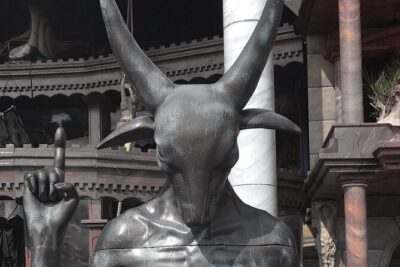
Munich Ghosts and Spirits Evening Walking Tour
Read our review →


Görlitz: Ghosts and Spooky Historical Night Walking Tour
Read our review →
Leipzig Old Cemetery: 75-Minute Dark History Tour
Read our review →Browse the lists this tour appears in