
REVIEW · ROME GHOST TOURS
Rome Secrets: Dark History & Tasty Bites Tour
Rome has a darker side. This two-hour evening walk takes you from the Jewish Ghetto to Ponte Sant’Angelo through tales of mysticism, ghosts, executions, poison, and forbidden ideas. I like the mix of unusual history and Roman food, especially the stop for pizza and the later taste of ciambelline al vino with wine. I also like that the route uses small passages and lesser-known corners instead of sticking only to Rome’s grand monuments.
The main drawback is the short running time. Two hours gives you a lively introduction, but several stops receive only about ten minutes. You will hear plenty of stories, yet you should not expect long interior visits or a slow meal. This is a walking story tour with snacks, not a full dinner or a formal church tour.
The guides are a major part of the experience. Simona receives especially warm praise for her passion, while Daniele is noted for his humor, archaeological background, and ability to make Rome’s past feel immediate. Sylvia, Daniel, and other guides have also been singled out for strong storytelling in different languages.
Key points to know before booking
- The route begins in Rome’s Jewish Ghetto, where Kabbalah, mysticism, the number seven, and the legend of the Golem set the mood.
- Food breaks are part of the storytelling, with Roman pizza, a drink, local sweets, and wine included in the listed package.
- Santa Maria dell’Orazione e Morte is the most macabre stop, with skulls, bones, and reminders of the nameless dead.
- The walk links famous names with overlooked places, including Giordano Bruno, Giulia Tofana, Mastro Titta, Passetto del Biscione, and Arco dei Banchi.
- The tour suits curious first-time visitors, particularly if you want history and folklore rather than another standard ancient-Rome overview.
- Private and small-group options are available, and the guide may speak English, French, Spanish, or Portuguese.
Starting at the Portico d’Ottavia
The meeting point is in front of the ruins of the Portico d’Ottavia, in the heart of the Jewish Ghetto. This is a good place to begin because the setting already feels older and more layered than the polished Rome of the main piazzas.
Your guide introduces the Jewish Ghetto through stories of mysticism and Kabbalah. The focus is not simply on buildings. You hear how symbols, numbers, legends, and religious traditions have shaped the way people understood Rome. The number seven receives special attention, as does the story of the Golem, a powerful figure from Jewish folklore.
I like this opening because it prepares you to see Rome as a city of ideas and fears, not just emperors and popes. The line between documented history and legend is part of the appeal. Your guide should make that distinction clear, but the mood remains atmospheric rather than academic.
The first food stop is in the Jewish Ghetto, where you get Roman pizza. The listed schedule allows about ten minutes for the tasting, so think of this as a generous snack rather than a sit-down meal. It is a practical touch early in the evening, particularly if you are coming straight from sightseeing and need something warm before the darker stories begin.
More Dark History Tours in Italy
- Rome: Guided Bar Crawl with Drinks & Dark History
★ 4.9 · 444 reviews - Rome: Small Group Rome’s Dark Side – Ghosts & Legends Tour
★ 4.9 · 343 reviews - Rome’s Dark Side Ghosts and Legends Tour
★ 5.0 · 93 reviews
Pizza, folklore, and the city’s smaller details
The food is not an afterthought. It gives the tour a pleasant rhythm: listen, walk, taste, then listen again. Pizza also helps keep the mood from becoming too grim too soon.
The exact food serving can vary. The inclusions list Roman pizza, one glass of beer, one glass of wine, and local sweets. Recent comments also refer to gelato, so you may find that the food stops change slightly by evening or guide. If a particular dish matters to you, confirm the current arrangement when booking.
After the first tasting, the tour moves into stories about Rome’s small sacred images, known as Madonnelle. These little religious pictures appear in unexpected corners of the city. They are easy to miss when you are rushing toward a major monument, but they reveal how faith once occupied ordinary streets and doorways.
This is one of the tour’s useful habits: it trains you to look up, slow down, and notice details that do not appear on a standard sightseeing route.
Passetto del Biscione and Rome’s secret corridors
Passetto del Biscione is one of the most appealing stops for photographers. It is an old frescoed passage, tucked between the larger sights, with an atmosphere that feels theatrical without being designed for tourists.
The stories connected with it involve secret meetings, forbidden romances, and quick escapes. These tales fit the place, but the passage also matters because it shows how much of Rome’s character survives in narrow spaces. A major square tells you how the city presented itself. A corridor like this tells you how people moved through it when they wanted privacy.
You will have time for photographs and a short explanation rather than a long examination of every fresco. Bring a phone or camera, but do not expect the corridor to be the only visual highlight. The pleasure comes from finding it and understanding why such a modest passage could carry so many stories.
Giordano Bruno in Campo de’ Fiori
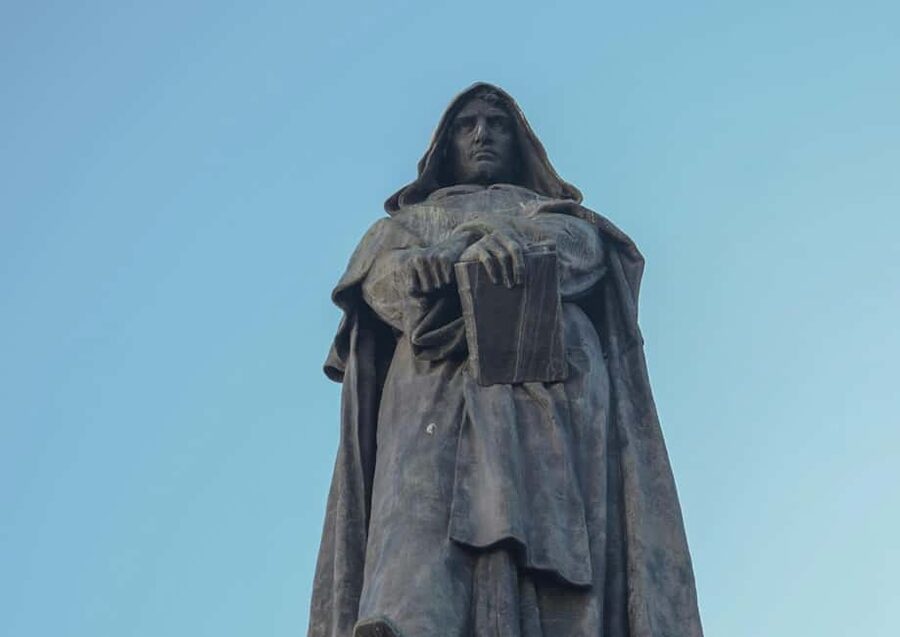
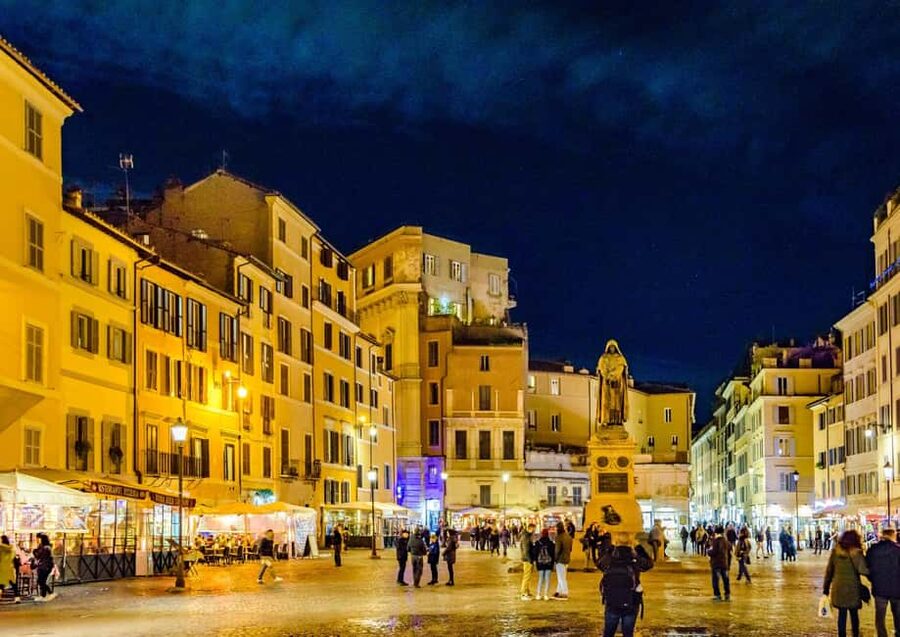
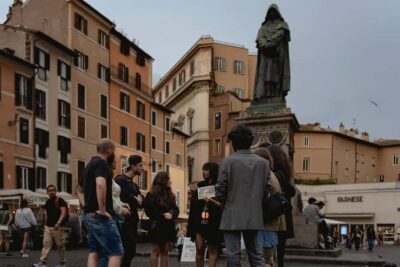
Campo de’ Fiori brings the tour into a more famous setting. During the day, the square is associated with its market and open-air activity. At night, the statue of Giordano Bruno gives it a more severe mood.
Bruno was burned alive for heresy in 1600. His bronze figure looks across the square as a symbol of free thought and forbidden knowledge. Your guide explains the circumstances around his execution and why his memory remains so powerful.
I find this stop valuable because it moves the tour beyond ghost tales. The story is unsettling not because it belongs to folklore, but because it concerns a real person punished for his ideas. Bruno becomes a bridge between Rome’s religious authority, intellectual life, and political fear.
The stop is brief, about ten minutes, so you will not receive a full biography. You will get the central facts and the larger question: who decides which ideas are acceptable? That question gives the tour more weight than a simple collection of spooky anecdotes.
More Dark History Tours in Rome
- Rome’s Dark Side: Ghosts, Scandals and Crypts – Small Group Tour
★ 5.0 · 28 reviews - Haunted Rome & True Crime: The Cenci Curse Game
★ 4.5 · 27 reviews - COMBO: Rome’s Capuchin Crypts Tour & Rome’s Dark Side Ghost Tour
★ 5.0 · 21 reviews - Ancient Rome’s Dark Side: Ghosts, Murders & Imperial Blood
★ 5.0 · 12 reviews
Skulls at Santa Maria dell’Orazione e Morte
The Church of Santa Maria dell’Orazione e Morte is the most visually direct stop on the route. Its name refers to prayer and death, and the façade is decorated with carved skulls. Inside and around the church, the imagery includes bones, mortality symbols, and macabre inscriptions.
The church was built to honor nameless people pulled from the Tiber River. That detail changes the mood. The skulls are not merely decoration for a gothic photo. They reflect a religious mission focused on people who died without family, identity, or a known burial place.
The scheduled stop is listed as a ten-minute photo stop. That means you should not count on an extended guided visit inside. The church may also be subject to opening conditions, so treat the exterior and its atmosphere as the dependable part of the stop.
For many people, this is the tour’s strongest visual moment. It is also the point where the theme of death becomes more grounded. The carved skulls remind you that Rome’s past includes ordinary people whose names disappeared, not only celebrated rulers and artists.
Via Giulia and the poison of Aqua Tofana
From the church, the route continues along Via Giulia, one of Rome’s elegant historic streets. Here, the guide tells the story of Giulia Tofana, the seventeenth-century poisoner associated with Aqua Tofana.
The tale concerns women who wanted to escape unhappy marriages and bought the poison as a lethal solution. It is a grim story, but it also opens a window onto a society where women could have very limited legal or personal freedom.
Your guide will likely frame Tofana as both a criminal and a figure shaped by the harsh conditions of her time. That balance matters. The story is more interesting when it is not reduced to a simple villain tale.
Via Giulia provides a fitting setting because its smooth, formal appearance contrasts with the betrayal and danger in the story. Rome often works this way. A beautiful street can carry a past that is far less beautiful.
Arco dei Banchi and movement through the city
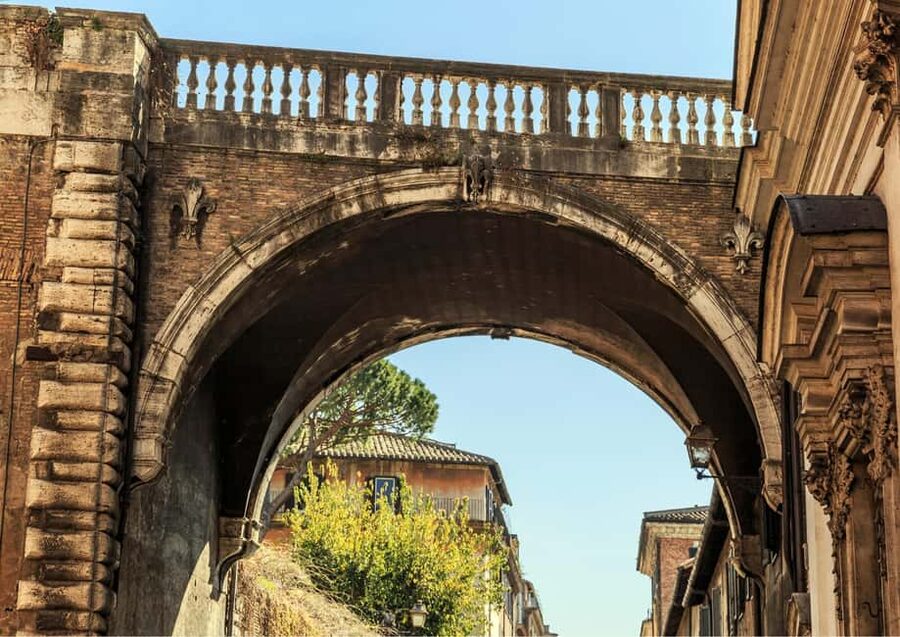
The route then passes beneath Arco dei Banchi, a passageway connected with movement between the Vatican and central Rome. Bankers, spies, and priests are said to have used it to pass through the city without being seen.
The arch is a good example of the tour’s approach. You are not stopping at a major monument for a long lecture. You are pausing in a passage that could easily be ignored, then hearing how ordinary infrastructure supported secrecy, commerce, and political life.
This part of the walk may appeal most to people who like urban history. The story is not only about dramatic characters. It is about how streets, arches, corridors, and bridges allowed people to work, worship, hide, and escape.
The route finishes near Via del Banco di Santo Spirito, close to Ponte Sant’Angelo. Wear shoes suited to cobblestones, since the walk moves through old streets and passages. The total distance is not provided, but the schedule involves continuous walking between several central locations.
Ciambelline, wine, and a gentler pause
Before the final stories, the tour balances the darker material with ciambelline al vino, traditional ring-shaped biscuits made with wine, plus a glass of wine. These are simple Roman treats, crisp and lightly sweet, and they make a fitting end to the food side of the evening.
One glass of beer is also listed among the inclusions. The timing may vary, since the schedule identifies two food tastings rather than naming every drink at each stop. What matters is that you receive more than a token bite. The tastings break up the walking and add a local food element without turning the tour into a restaurant crawl.
The food is best viewed as part of the experience rather than the reason to book it alone. If you want several courses, generous portions, or time to sit and compare dishes, choose a dedicated food tour instead. If you like a small taste paired with a story, this format works well.
Ponte Sant’Angelo and the story of Mastro Titta
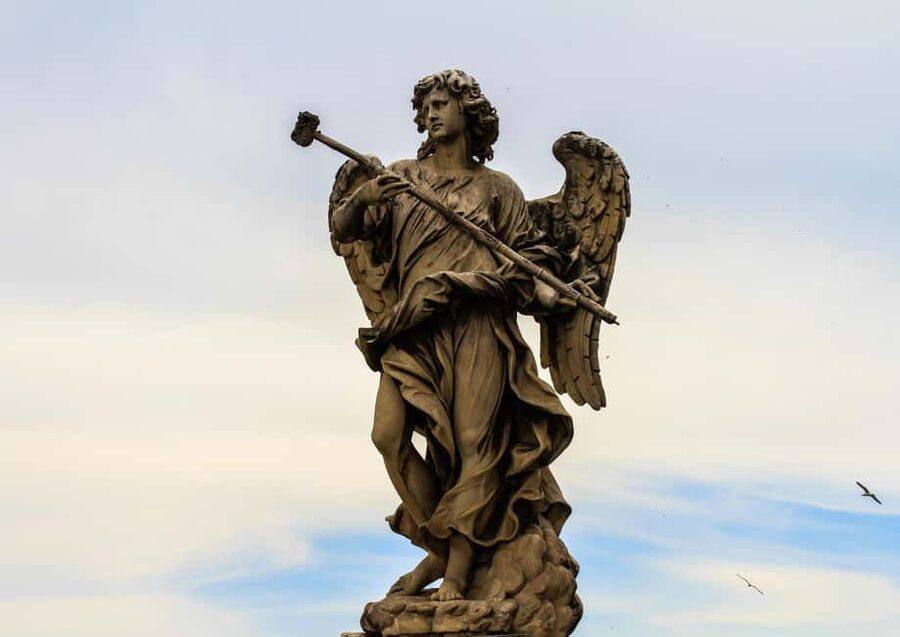
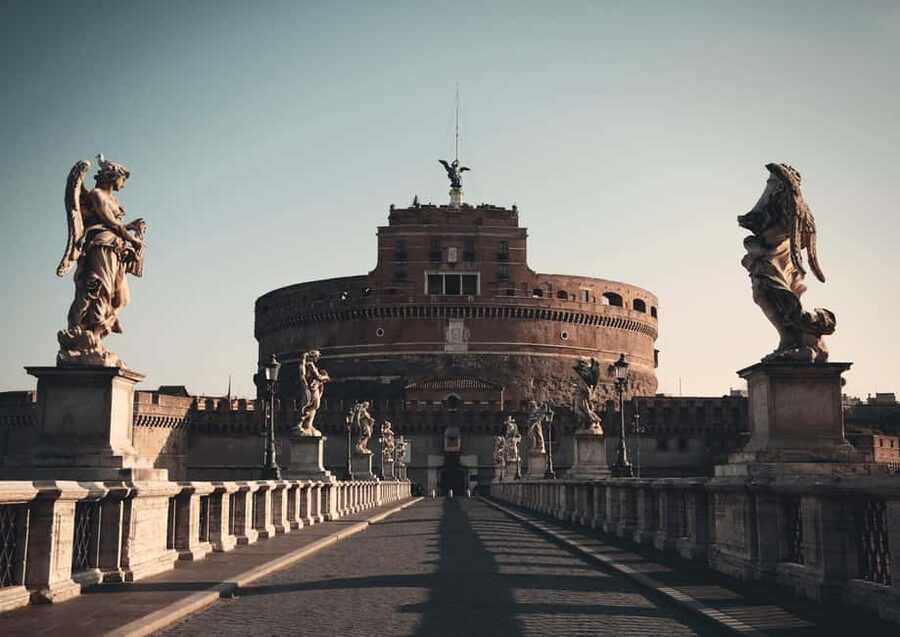
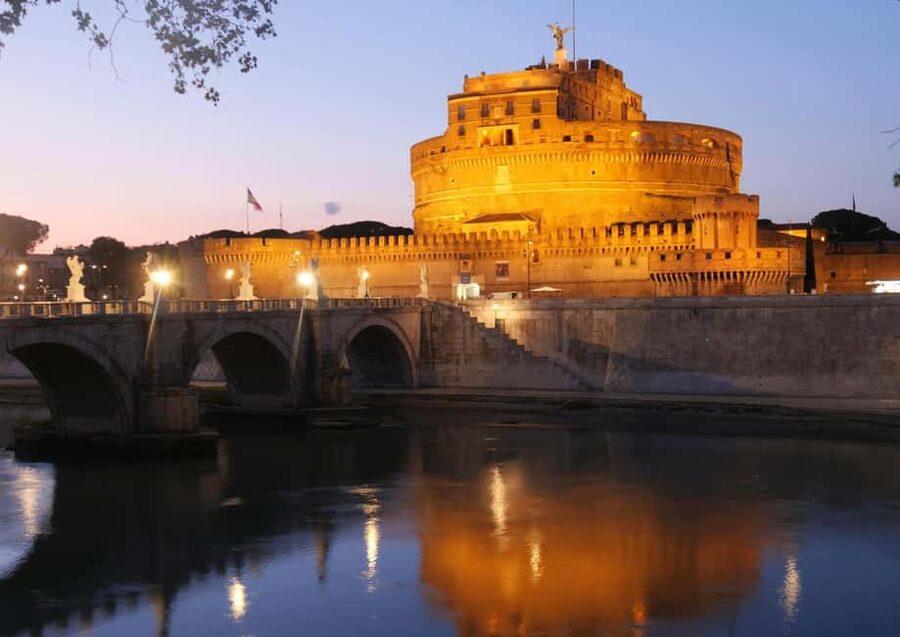
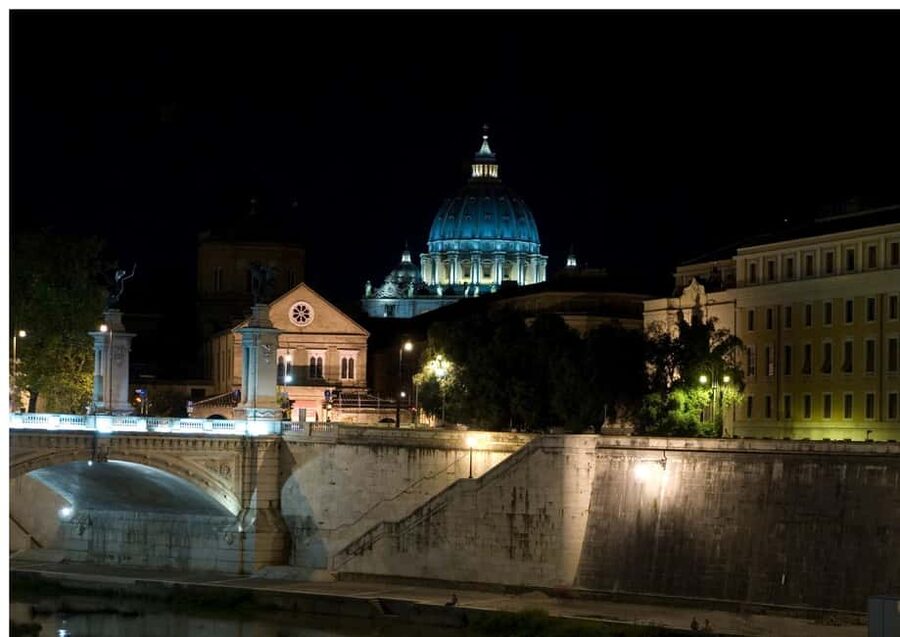
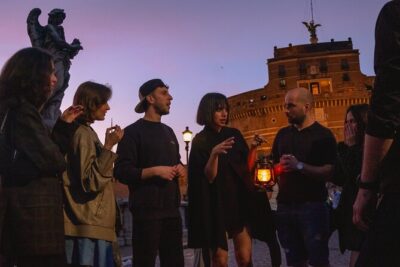
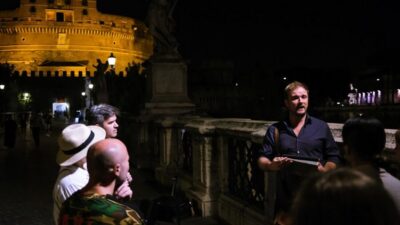
The final photo stop is near Ponte Sant’Angelo, with the route ending on Via del Banco di Santo Spirito. The bridge and nearby Castel Sant’Angelo area give the evening a dramatic setting, particularly as daylight fades.
Here you hear about Mastro Titta, Rome’s most notorious executioner. His work was gruesome, but his personality and place in Roman society were more complicated than the title suggests. The story makes a strong finale because it brings together the tour’s main subjects: law, public punishment, fear, spectacle, and memory.
You should not expect a long stop on the bridge. The schedule allows about five minutes for the final photo opportunity. Still, the setting gives the ending a sense of scale after the narrow corridors and small churches earlier in the walk.
One useful tip is to book this experience early in your Rome stay. Several people describe it as a good first-night activity because it gives you history, food, and an introduction to streets you might otherwise miss. It can also help you get your bearings in the central area before exploring alone.
Guide quality and group choices
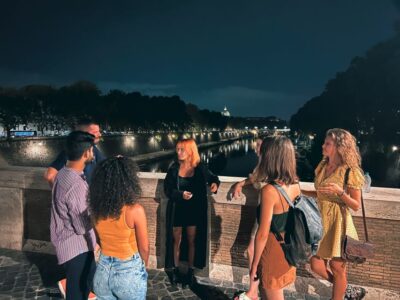
The guide can make or break a story-led walk. The strongest feedback centers on the guides’ ability to combine facts with humor, folklore, and personal enthusiasm.
Daniele receives especially high praise for his passion and archaeological background. His approach appears to suit people who want more than a string of ghost stories. Simona is also praised for making the history clear and personal, while Sylvia is noted for blending history lessons with folklore.
You can choose a private or small-group format. A smaller group should make it easier to hear the guide in narrow streets and ask questions, though the available information does not give fixed maximum group sizes. Languages offered are English, French, Spanish, and Portuguese.
Because the tour depends so much on narration, listen for the guide’s handling of fact and legend. The best version of this experience will let you enjoy the stories without confusing every dramatic tale with proven history.
Is $40 a fair price?
At $40 per person, the value is solid if you want a guided evening walk with several tastings. You are paying for two hours of live guiding, Roman pizza, a beer, wine, and local sweets, along with access to a carefully connected route through several central neighborhoods.
The price is less compelling if your main goal is a full meal or long visits inside churches. The food portions are designed as tastings, and some stops are short. You are buying context, atmosphere, and storytelling as much as you are buying food.
The free cancellation option up to 24 hours before the start gives you useful flexibility. You can also reserve now and pay later, which helps if your Rome schedule is still changing. Check the available starting times because the tour duration is fixed at two hours, but the departure time can vary.
Who should book this Rome evening walk?
I would choose this tour if you enjoy history that sits between fact and folklore. It suits first-time Rome visitors who have already seen the obvious monuments, as well as repeat visitors who want a different angle on familiar neighborhoods.
It is also a good fit for couples, small groups, and curious solo visitors who prefer a guide to a formal museum lecture. The mix of pizza, wine, biscuits, churches, alleys, and unsettling stories gives the evening plenty of variety.
I would skip it if you dislike walking on cobblestones, have little interest in death or religious imagery, or want a relaxed dinner with generous portions. Santa Maria dell’Orazione e Morte and the execution stories are not light entertainment, even though the food and humor keep the evening from becoming oppressive.
Final verdict: book it for the stories, not just the snacks
Book Rome Secrets if you want Rome’s lesser-seen corners explained by an energetic guide. The strongest reasons are the unusual route, the mix of documented events and legend, and the guides, especially Daniele and Simona. The food makes the two hours more enjoyable, but the storytelling is the real value.
At $40, it is a sensible choice for an early evening introduction to the Jewish Ghetto, Campo de’ Fiori, Via Giulia, and Ponte Sant’Angelo. Just keep your expectations clear: this is a brisk walking tour with tastings and brief stops, not a full meal or a long church visit.
FAQ
Where does the tour begin?
It begins at the Portico d’Ottavia in Rome’s Jewish Ghetto, in front of the ruins of the porch.
Where does the tour finish?
The tour finishes at Via del Banco di Santo Spirito, near the Ponte Sant’Angelo area.
How long does the experience last?
The tour lasts two hours.
What food is included?
The listed food includes Roman pizza and local sweets, including ciambelline al vino in the tour description.
What drinks are included?
The inclusions list one glass of beer and one glass of wine.
Is the tour available in English?
Yes. Live guiding is available in English, French, Spanish, and Portuguese.
Is this a private tour?
You can choose a private or small-group option.
What places are visited?
The route includes the Jewish Ghetto, Campo de’ Fiori, Santa Maria dell’Orazione e Morte, Via Giulia, Arco dei Banchi, and the area near Ponte Sant’Angelo.
Can I cancel for a full refund?
You can cancel up to 24 hours in advance for a full refund.
Can I reserve now and pay later?
Yes. The tour allows you to reserve now and pay later, so you do not have to pay at the time of booking.
More Heritage Tours in Rome
- Rome After Dark Mysteries Myths and Haunted History
★ 5.0 · 14 reviews - Rome: Colosseum and Ancient Dark History Walking Tour
★ 5.0 · 10 reviews - Rome Secrets with Dark History and Tasty Bites Tour Experience
★ 4.5 · 3 reviews - Savannah History and Haunts Candlelit Ghost Walking Tour
★ 5.0 · 3,235 reviews
Newly added around Rome
- Rome Secrets with Dark History and Tasty Bites Tour Experience★ 4.5 · 3 reviews
- Rome After Dark Mysteries Myths and Haunted History★ 5.0 · 14 reviews
- Ghost & Legends in Night Rome Walking Tour★ 5.0 · 36 reviews
- Rome: Private Night Ghost Walking Tour★ 5.0 · 38 reviews
- Haunted Rome: Eternal City Night Walking Tour★ 5.0 · 38 reviews
- Experience Rome in this Mysterious Ghost Tour★ 3.5 · 3 reviews
- Haunted Rome & True Crime: The Cenci Curse Game★ 4.5 · 27 reviews
- Rome’s Dark Side: Ghosts, Scandals and Crypts – Small Group Tour★ 5.0 · 28 reviews
Rome Ghost Tours, compared.
Paranormal Night Walking Tour & Secret Backstreets
Read our review →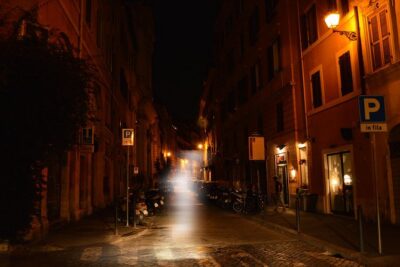
Small Group Rome’s Dark Side – Ghosts & Legends Tour
Read our review →
Ghosts, Legends & Mysteries of Rome Tip-Based Walking Tour
Read our review →
Browse the lists this tour appears in