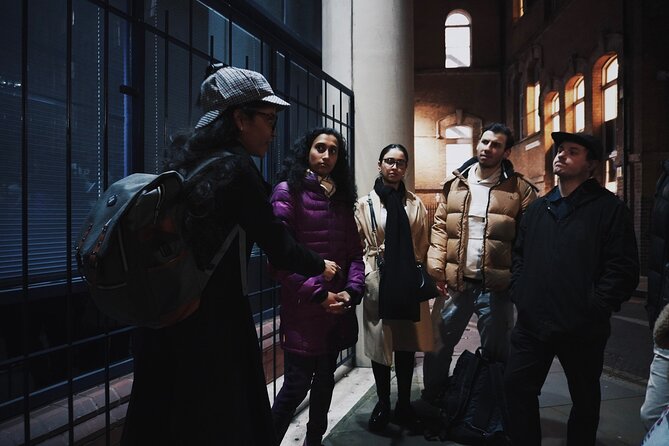
REVIEW · LONDON GHOST TOURS
Jack the Ripper: Night Murder Mystery Walking Tour in London
London gets darker after sunset. This two-and-a-half-hour Whitechapel walk links real locations to the Jack the Ripper murders, mixing Victorian social history, crime-scene clues, and competing theories. I like the chronological route and the attention given to the women behind the case, not just the killer.
I also like the small-group limit of 25 and the chance to finish near the Ten Bells pub, one of the area’s most famous Ripper landmarks. The main drawback is simple: you walk for most of the evening, often stop outdoors, and may find it hard to hear if the guide turns away from the group.
Key things to know before you book
- The route follows the murders in sequence, helping you understand how the story developed rather than hearing a jumble of names and dates.
- The victims receive serious attention, with discussion of their lives, poverty, and vulnerability in Victorian London.
- The setting does much of the work, from narrow passages to old streets connected with the crimes.
- The guides add theories and local history, with guides such as Tyson, Kory, Dougal, Hadi, Anahita, and Korhan praised for strong storytelling.
- The $22.93 price is fair for the length, especially compared with shorter evening walks, though you should dress for cool or wet weather.
- The tour ends at Mitre Square, while the route includes the Ten Bells pub and several Whitechapel crime sites.
Why this Whitechapel walk works so well at night
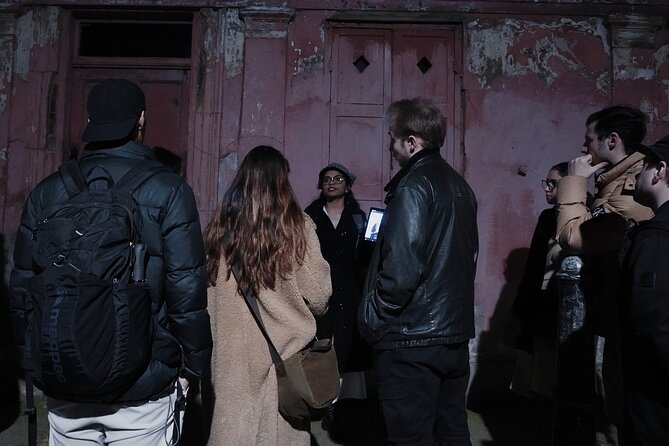
Jack the Ripper is a familiar name, but the case can feel vague if you only know the broad outline. This walk gives the story a physical shape. You move from street to street, connect each location with a specific event, and see how close many of the sites are to one another.
That matters because the murders were not scattered across some distant part of London. They happened in a compact district marked by poverty, overcrowding, lodging houses, pubs, dark passages, and heavy foot traffic. The route helps you picture the conditions that shaped the lives of the women involved.
The guide presents the material in a Ripperologist style, combining documented facts with theories about the killer’s identity. You should expect mystery, but not a clean solution. The appeal is in sorting evidence from speculation and hearing why some theories have lasted for more than a century.
The night setting adds atmosphere without requiring theatrical gimmicks. A cloudy evening, narrow street, or poorly lit corner can make the past feel closer. Still, the guide’s storytelling matters more than the darkness. The strongest guides, including Tyson, Kory, Dougal, Hadi, and Korhan, have been praised for making the subject clear, human, and respectful.
More Dark History Tours in London
- Interactive Jack the Ripper Night Walk: London’s Murder Mystery
★ 5.0 · 171 reviews - Jack the Ripper Tour: Murder, Mystery, & the Women of Whitechapel
★ 5.0 · 40 reviews - Jack the Ripper: Solve the Crime Walking Tour (Kids Free!)
★ 4.5 · 36 reviews
Starting at St Marys Whitechapel Church Memorial
The meeting point is St Marys Whitechapel Church Memorial on an unnamed road in London E1 1FE. Your confirmation arrives at booking, so check the meeting instructions carefully before setting out.
The opening section introduces Whitechapel as a Victorian district shaped by poverty and overcrowding. This is an important choice. Instead of treating the murders as isolated acts of horror, the guide explains the social setting around them.
You learn how women living with very few resources could be pushed into dangerous situations. You also get a sense of why the area provided cover for crime. Streets could be crowded yet confusing, and many people had little protection or social power.
This opening may feel less dramatic than a murder scene, but it gives the rest of the tour a stronger base. I would rather spend time understanding the district than hear a string of sensational details with no context.
Brick Lane and the world behind the headlines
The first major stop is Brick Lane, now known for food, markets, and street culture. The tour looks back to its role in Victorian slum life, when poverty and crowded housing shaped everyday existence.
The useful point here is contrast. You are standing in a place that feels lively and modern while hearing about a very different urban world. The guide explains the conditions that made Whitechapel vulnerable, including desperation, overcrowding, and limited options for women trying to survive.
You should not expect admission charges at these stops. This is a walking experience through public streets, so the value comes from the guide’s interpretation rather than access to a museum or private building.
Brick Lane is also a good reminder that London changes quickly. The modern street does not recreate the Victorian district, but the route helps you imagine what has disappeared and what traces remain.
Princelet Street and the victims’ daily lives
Princelet Street is quieter and narrower. Here the discussion turns more directly toward the women connected with the case, including Annie Chapman and the conditions in which women like her lived.
This part can be more affecting than the familiar killer theories. The women were not simply names attached to a crime list. They had difficult lives, relationships, work, and daily routines before the murders turned them into historical figures.
The guide uses the street to explain how vulnerable people moved through the neighborhood. You hear about the pressures facing women with little money and few safe places to go. The strongest presentations keep the focus on their humanity rather than treating them as props in a ghost story.
I especially value this approach because it changes the tone of the walk. You still get clues and theories, but the people involved do not disappear behind the legend of Jack the Ripper.
More Dark History Tours in the UK
- Jack The Ripper Tour : Solve The Crime
★ 4.5 · 28 reviews - Dark History of the Tudors: Private Tour of Hampton Court Palace
★ 5.0 · 10 reviews - Jack the Ripper Walking Tour: Murder, Mystery, & the Women
★ 4.2 · 6 reviews - The murders of Jack the Ripper with a pub
★ 5.0 · 2 reviews
Puma Court and the power of a narrow passage
Puma Court remains close to its nineteenth-century appearance, making it one of the more atmospheric parts of the route. It is narrow, enclosed, and easy to imagine as a place where someone could vanish from view.
The point is not that the modern street looks exactly as it did during the murders. It is that the layout helps you understand how darkness, corners, and limited visibility could affect movement through Whitechapel.
This is one of the stops where the physical setting carries real weight. You do not need a display case or a dramatic prop. A confined passage and a careful explanation can make the geography of the case easier to understand.
The drawback is practical. Small streets can make it harder for everyone to hear, especially if several groups gather nearby. Stay close to the guide and position yourself where you can see the guide’s face.
The Ten Bells and a famous Ripper connection
The Ten Bells pub is one of the best-known names linked to the case. The tour stops outside the pub and explains why several victims are believed to have visited it before their deaths.
You learn about the women’s final hours and the pub’s place in the story. The guide also explains how the location became part of the lasting Ripper mythology.
Do not expect this stop to function as a pub visit or a long seated break. The scheduled tour finishes at Mitre Square, and the Ten Bells is treated as a historical location along the route. If you want a drink inside, that would be a separate plan.
This stop gives the walk a strong sense of place. A pub can seem ordinary today, but its repeated appearance in the case has made it a powerful symbol of Whitechapel’s past. It also helps connect the murders to ordinary routines, including drinking, meeting people, and looking for shelter.
Gunthorpe Street and Martha Tabram
Gunthorpe Street is linked with the murder of Martha Tabram, who may have been Jack the Ripper’s first victim. That may is important. Her inclusion in the official Ripper story remains a matter of debate.
The guide examines the evidence and explains why some experts include her while others do not. This is where the interactive mystery element becomes useful. You are not simply handed a final answer. You are encouraged to consider the clues and decide how convincing the connection seems.
The street itself is narrow and carries a grim sense of enclosure. Hearing the case in chronological order also helps. Martha Tabram’s death becomes part of a developing pattern rather than an unrelated event added later.
If you enjoy crime history, this may be one of the most engaging stops because it shows how uncertain the case remains. The line between fact and theory is not always neat, and a good guide makes that clear.
Goulston Street, the apron, and the chalk message
Goulston Street brings one of the case’s most famous clues into focus. A bloody piece of apron belonging to Catherine Eddowes was found here. Nearby, a chalk message created further controversy and fueled theories that still attract attention.
This stop is less about a single dramatic answer and more about how evidence can become tangled with rumor. The guide explains the clue, the message, and the questions surrounding them.
The best way to approach this section is to listen for what is documented and what is interpretation. The guide may offer a theory about the killer’s identity, but you should expect room for doubt. That uncertainty is part of the case’s lasting appeal.
Several guides have stayed after the formal walk to discuss theories. Tyson and Kory, in particular, were praised for answering questions and continuing the conversation. If you want the full value from this part of the tour, save your most detailed questions for the final discussion.
St Botolph without Aldgate and a moment to reflect
St Botolph without Aldgate adds a quieter, more reflective stop. The church was associated with women seeking refuge, and the guide uses the location to discuss the lack of support available to vulnerable women.
This is where the tour moves beyond crime solving. The women were living in a society that offered few safe choices to those without money, stable housing, or family support. Their circumstances are not an excuse for the murders, but they are necessary to understand the setting.
The pause also breaks up the sequence of clues. After several dark locations, a church provides space to consider the human cost. Guides who handle the subject well do not make jokes at the victims’ expense or rely on graphic detail. Hadi received especially strong praise for presenting the material with care, calm, and respect.
The final stretch to Mitre Square
The tour ends at Mitre Square, London EC3A 5DE. The route’s final section brings together the murder sequence and the unresolved questions about the killer.
This ending works because you have already seen the area in order. Rather than beginning with the most famous mystery and jumping backward, the guide builds the story step by step. You can follow how the crimes, clues, and theories developed.
The ending is not a tidy solution. Jack the Ripper’s identity remains unresolved, and the tour keeps the distinction between known evidence and later speculation. That makes the experience more useful for anyone who wants history rather than a staged horror show.
One detail deserves care when planning: the provided description refers to a final victim at Mitre Square, but the route information identifies Mitre Square as the ending point without making that claim consistent. Treat the stop as the conclusion of the walking route and the case discussion, not as a promise of a definitive final revelation.
Guides, group size, and the listening problem
The maximum group size is 25. That is large enough to create energy but small enough for a guide to keep the group together. Several guides have been praised for waiting briefly when people fell behind and for checking that no one was left behind during transport disruptions.
The guide can make or break this experience. Tyson is noted for humor and a positive attitude, even in heavy rain. Kory and Korey received praise for detailed storytelling, local history, old news reports, and historical photographs. Dougal was praised for painting a vivid picture of nineteenth-century London, while Hadi was singled out for careful treatment of the victims.
One practical weakness has also appeared: it can be hard to hear when a guide looks away while speaking. This is a common issue on street walks, especially near traffic or other groups. Stand near the front, keep the group tight, and politely ask the guide to repeat anything you miss.
Price, weather, and physical effort
At $22.93 per person, the tour offers about two and a half hours of guided walking through central Whitechapel. That is a reasonable price for an evening activity, particularly because the route covers several locations and includes historical explanation rather than only a short ghost story.
The value is strongest if you want context. You are paying for the guide’s research, order, and ability to explain why each place matters. If you only want dramatic photographs or a quick introduction to the Ripper case, the length may feel demanding.
You should plan for continuous walking and limited chances to sit before the end. Wear comfortable shoes and bring layers. Rain can affect the experience, though Tyson’s ability to keep a group engaged in torrential downpours suggests that bad weather does not automatically ruin the evening. Still, a waterproof jacket will help more than optimism.
The tour is offered in English and includes mobile ticketing. Service animals are allowed, and most people can participate, but the amount of standing and walking deserves attention before booking. Group discounts may also be available, which could improve the value for families or friends traveling together.
Free cancellation is available up to 24 hours before the start time for a full refund. Changes or cancellations within 24 hours are not refunded, with cutoffs based on local London time.
Who should book this London night tour?
I would recommend it to anyone interested in Victorian London, true crime, social history, or guided walks with a mystery element. It also suits repeat visitors who want to explore East London through a focused subject rather than a standard sightseeing route.
It is a particularly good choice if you want the victims’ stories treated with respect. The best parts do not glorify the killer. They explain the women’s lives, the poverty around them, and the failures that left them exposed.
I would hesitate to recommend it to anyone who dislikes gruesome subject matter, long outdoor walks, or unresolved historical questions. The tour is not a comfortable pub crawl, and you should not expect to sit down often.
Should you book the Jack the Ripper night walk?
Book it if you want a well-paced, affordable walk that connects Whitechapel’s streets with a famous unsolved case. The chronological route, victim-focused storytelling, and strong guides give it more substance than a simple scare tour.
Choose an evening with a reasonable weather forecast, arrive ready to walk, and stay near the guide so you can hear every detail. At $22.93, the experience offers solid value, especially for fans of dark history who want atmosphere without losing sight of the real people behind the legend.
FAQ
How long is the Jack the Ripper walking tour?
The tour lasts approximately two hours and 30 minutes.
Where does the tour start?
It starts at St Marys Whitechapel Church Memorial, on an unnamed road in London E1 1FE, United Kingdom.
Where does the tour end?
The tour ends at Mitre Square, London EC3A 5DE.
Is the tour offered in English?
Yes. The tour is offered in English.
How many people can join the tour?
The maximum group size is 25 people.
Does the tour include the Ten Bells pub?
Yes. The route stops outside the Ten Bells to discuss its connection with the Ripper case. The supplied details do not state that a drink or indoor pub visit is included.
Can most people take part?
Yes. Most people can participate, and service animals are allowed. Keep in mind that the experience involves extended walking and standing.
What is the cancellation policy?
You can cancel at least 24 hours before the start time for a full refund. Cancellations or changes made within 24 hours are not refunded.
More Ghost Walking Tours in the UK
- London Jack The Ripper Small-Group Walking Tour
★ 5.0 · 1,013 reviews - Ghastly Ghost Walking Tour in London
★ 5.0 · 878 reviews - London: Ghastly Ghosts 2-Hour Walking Tour
★ 4.9 · 794 reviews - London: Jack the Ripper Walking Tour
★ 4.2 · 410 reviews
More Ghost Walking Tours in London
- London: The Original Jack the Ripper Walking Tour
★ 4.7 · 7,833 reviews - London Jack The Ripper Guided Walking Tour
★ 5.0 · 3,131 reviews - London: Jack the Ripper Evening Walking Tour
★ 4.9 · 1,449 reviews - London: Ghost Walk and River Thames Boat Ride
★ 4.5 · 1,251 reviews
Newly added around London
- Wicked Whitechapel: Where Now’s Jack The Ripper Audio Tour★ 5.0 · 2 reviews
- Ghosts, Gore & Other Ghasty Stories in the City of London★ 5.0 · 7 reviews
- Afternoon Jack the Ripper : Guided Tour★ 5.0 · 183 reviews
- Visit Jack the Ripper in French★ 5.0 · 33 reviews
- The Fading Light London Ghost Walk★ 5.0 · 35 reviews
- Self-Guided Audio Tour-Behind the shadow of evil: Jack the Ripper★ 4.0 · 2 reviews
- The Haunted Pubs of Old London: Small Group Tour★ 5.0 · 38 reviews
- Jack the Ripper – What About the Women?★ 5.0 · 39 reviews
London Ghost Tours, compared.
London Jack the Ripper Guided Tour with Ripper-Vision
Read our review →
Ghost, Ghouls and Gallows Tour : Guided Tour with Boat Ride
Read our review →
Jack the Ripper Tour with Immersive Ripper Vision
Read our review →