
REVIEW · ROME GHOST TOURS
Ancient Rome’s Dark Side: Ghosts, Murders & Imperial Blood
Rome gets more interesting after sunset. This two-hour walk turns familiar ruins into a stage for assassinations, poison, prophecy, and ghost stories, linking famous sights with lesser-known corners of the city. You move from Largo Argentina to the Colosseum while an English-speaking guide supplies the grim tales.
I especially like the night setting, which brings cooler air and fewer crowds, and the route’s unusual focus on places many daytime tours skip. The small maximum of 15 people also gives the walk a more personal feel. The main drawback is that this is an outdoor storytelling tour, not an entry tour, so you will view archaeological sites from outside rather than walk through museums or monuments.
The stories are theatrical, but the route is grounded in real Roman places and documented political violence. Ivana, one praised guide, was noted for making the material entertaining while keeping the historical context in view. For a reasonable $30.10, this is a good evening choice if you want something beyond the standard postcard tour.
What makes this Rome night walk worth considering
- Julius Caesar’s assassination site: Begin at Largo Argentina, where Caesar was attacked in 44 BCE, then hear how his ghost was said to pursue his killers.
- Imperial family poison and murder: The stops at Teatro di Marcello and Capitoline Hill explore Livia’s alleged crimes and Caligula’s violent end.
- Small-group format: The tour is limited to 15 people, useful when you are listening to a guide outdoors in busy central Rome.
- A route beyond the usual checklist: Monti, the Carcer Tullianum, and the Borgia staircase add corners that may not appear on a first Rome itinerary.
- Cooler evening conditions: The 8 p.m. start avoids the worst daytime heat and offers a different view of central Rome.
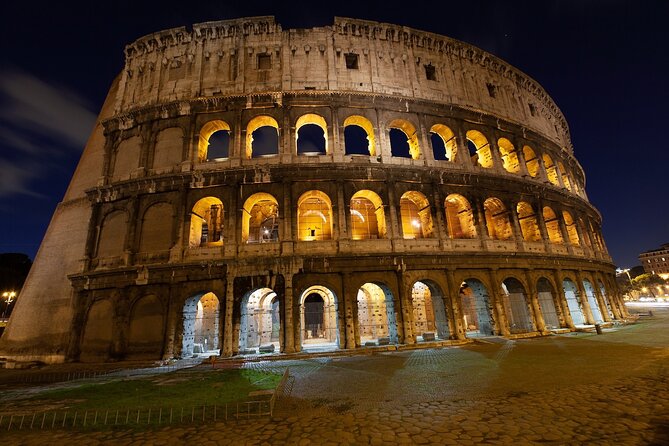
- A dramatic finish: The walk ends above the Colosseum metro stop, with a view toward the arena and its grim past.
Why Rome’s darker stories work best after sunset
This experience is not a haunted-house show. It is a guided walk through Roman political history, with ghost legends used to give old events a sharper edge. The subject matter is serious: murder, execution, betrayal, poisoning, and people denied proper burial.
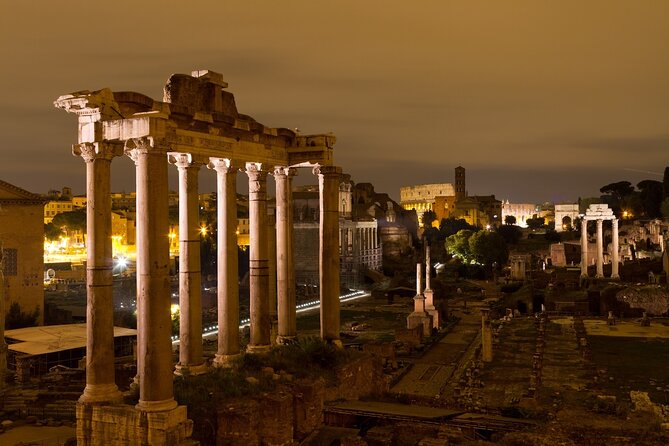
That mix suits Rome particularly well. Ancient monuments often survive as broken walls, scattered columns, and partial foundations. A skilled storyteller helps you picture what happened in those spaces. At night, you also have less glare and heat to contend with, though darkness can make some ruins harder to see clearly.
I like the balance described by the tour’s strongest feedback. The guide is expected to know the ancient world well, but the evening is not presented as a university lecture. The best moments combine factual context with a strange Roman belief, such as a murdered ruler returning as a ghost or a cursed street carrying the memory of violence.
The 8 p.m. start is sensible. Rome can be hot and tiring during the day, especially when you are already visiting the Forum, Palatine Hill, or Colosseum. This walk gives you an evening activity after dinner or before a late meal, though the optional snack and drink stop means you should not count on it as a full dining break.
More Dark History Tours in Italy
- Rome: Guided Bar Crawl with Drinks & Dark History
★ 4.9 · 444 reviews - Rome: Small Group Rome’s Dark Side – Ghosts & Legends Tour
★ 4.9 · 343 reviews - Rome’s Dark Side Ghosts and Legends Tour
★ 5.0 · 93 reviews
Largo Argentina: beginning where Caesar fell
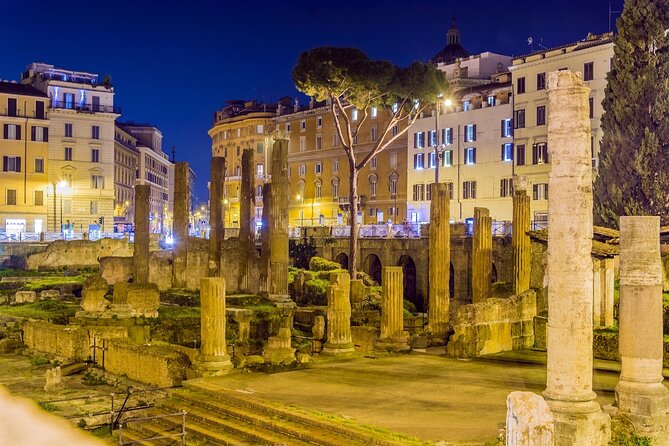
The meeting point is Largo di Torre Argentina, a central location known for its ancient temple ruins and cat sanctuary. The first stop is the Area Sacra di Largo Argentina, where you stand above the site associated with Julius Caesar’s assassination in 44 BCE.
The guide uses the location to explain more than the stabbing itself. You hear about the political chaos that followed, the men involved in the conspiracy, and the stories that Caesar’s spirit returned to trouble those who betrayed him.
This is a strong opening because the place gives you an immediate physical connection to the story. You are not simply hearing about Caesar in an abstract classroom setting. You are looking down into the remains of the ancient complex while the guide points out how the site fits into the story.
The stop lasts about 10 minutes, so expect a focused introduction rather than a long archaeological explanation. Admission is not included because the tour remains outdoors, but you do not need a separate ticket for the view and storytelling here.
Teatro di Marcello and the politics of poison
From Largo Argentina, the route continues to Teatro di Marcello, one of Rome’s oldest surviving theaters. Its curved stone remains are impressive even from outside, and the setting supports a story about power inside the imperial household.
Here the subject is Livia, the wife of Augustus and mother of Tiberius. She has often been portrayed in popular culture as a master of political manipulation, and the tour examines accusations that she eliminated rivals, possibly including her own stepson, to protect her son’s path to the throne.
The important point is that this is a story of allegations and imperial rumor, not a simple court verdict. Roman politics produced plenty of enemies, and later writers were not always neutral. A good guide should help you separate what is firmly recorded from what became part of the darker legend.
The theater itself gives you a welcome change from the usual Forum material. You are still seeing ancient Rome, but through a building connected to public entertainment and elite power. Like the first stop, this section lasts around 10 minutes and is viewed from outside.
Capitoline Hill and the shadow of Caligula
Capitoline Hill offers one of the route’s best viewpoints. You look toward the Roman Forum and Palatine Hill, areas tied to the emperors and their households. The view helps connect the scattered ruins below with the imperial world described in the stories.
The focus here is Caligula, whose reputation for cruelty and instability has grown over the centuries. The guide explains how his rule ended in assassination and how tales of his ghost lingered around the palace after his death.
This stop works because it joins geography to character. The Palatine was home to emperors, but it can be difficult to imagine court life when you are looking at broken foundations. The story of Caligula gives those ruins a human, if deeply unpleasant, presence.
You should not expect to enter the Capitoline Museums or any Palatine building on this experience. The value is the nighttime viewpoint and the guide’s narration. If you want detailed architectural study, book a separate daytime visit to the Forum and Palatine Hill.
More Dark History Tours in Rome
- Rome Secrets: Dark History & Tasty Bites Tour
★ 5.0 · 37 reviews - Rome’s Dark Side: Ghosts, Scandals and Crypts – Small Group Tour
★ 5.0 · 28 reviews - Haunted Rome & True Crime: The Cenci Curse Game
★ 4.5 · 27 reviews - COMBO: Rome’s Capuchin Crypts Tour & Rome’s Dark Side Ghost Tour
★ 5.0 · 21 reviews
The Tullianum: Rome’s prison and execution site
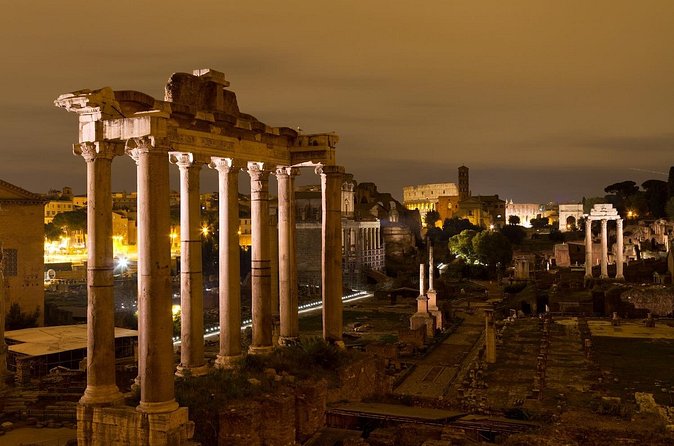
The walk then reaches the Carcer Tullianum, traditionally identified as Rome’s ancient prison. The tour stops beside the steps and entrance, where the guide describes how enemies of the state were held, executed, and left without proper burial.
This part is darker than the ghost stories because the cruelty was practical and political. Powerful prisoners could be strangled underground, while defeated enemies might disappear from public view. The lack of a proper burial mattered greatly in Roman belief, since an unsettled dead person could not easily pass into the next world.
The site is small and atmospheric, but keep your expectations clear. You are standing beside the entrance rather than receiving admission to the prison interior. The tour information specifically says archaeological sites and museums are not included.
For me, this is one of the stops that gives the walk weight. The Colosseum is the obvious symbol of Roman violence, but the Tullianum shows how violence also operated in government buildings and prison cells.
Via dei Fori Imperiali and Domitian’s fatal prophecy
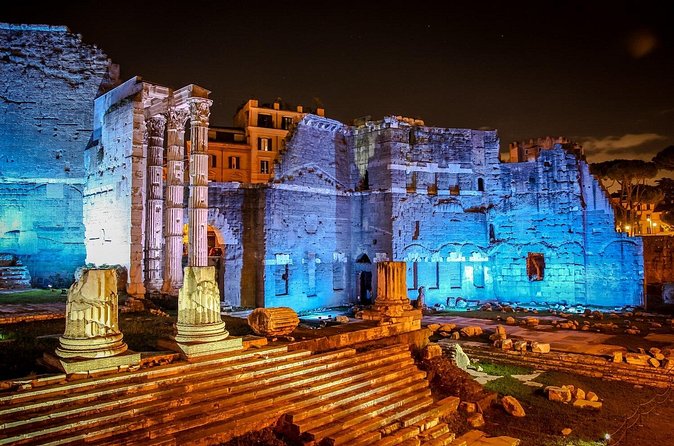
Along Via dei Fori Imperiali, the story turns to Domitian and the forum connected with his rule. Domitian was an emperor who took omens and prophecies seriously, and the tour tells how he tried to avoid a prediction about the hour of his death.
The grim twist is that he was murdered at the very hour he feared. His memory was then attacked through a process often called the erasure of public honor, with his name removed from monuments and official references. The story also includes servants who feared his ghost after his death.
This stop shows how Roman power depended on public memory. An emperor could command statues, inscriptions, and ceremonies during his lifetime, but political enemies could try to remove him afterward. The physical remains along the avenue make that idea easier to grasp, even when the original structures are incomplete.
The stop lasts about 10 minutes. Because the route is outdoors and the Imperial Forums are not entered, you are paying for the interpretation rather than access to the ruins themselves.
Monti and the old Suburra
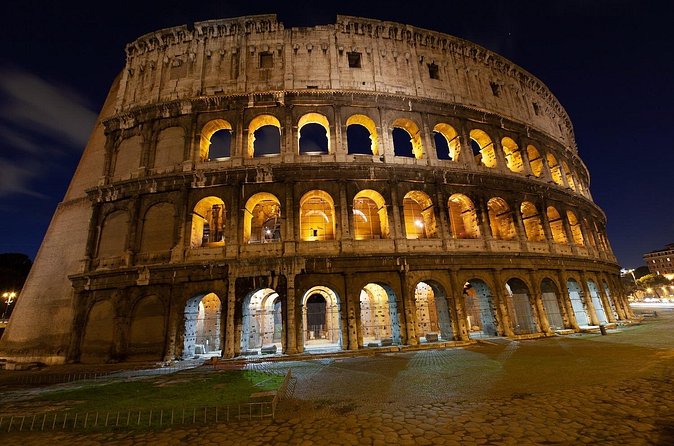
Monti brings a change of mood. The neighborhood occupies part of what was once known as the Suburra, a rougher and more disreputable district of ancient Rome. Today, the area is a popular central neighborhood, but the tour uses its older reputation as the setting for the story of Messalina.
Messalina, wife of Emperor Claudius, became famous for alleged sexual scandals and political schemes. The tale told here describes her walking through the district at night, with her ghost said to remain in its shadows.
This is the longest stop, at about 15 minutes, which makes sense. The story needs more background, and Monti offers streets rather than one single monument. You get a sense of Rome as a lived-in city, not just a collection of official ruins.
This is also a good point to judge your own interest. If you enjoy scandal, rumor, and personalities, you will likely find the story entertaining. If you prefer archaeology with little legend, this section may feel more theatrical than the earlier stops.
The Borgia staircase and a street marked by violence
Near the Scalinata dei Borgia, the guide discusses the ancient Vicus Sceleratus, or Accursed Street. The central story concerns a Roman princess who drove her chariot over the body of her murdered father.
It is a brutal image, but the purpose goes beyond shock. The story shows how Romans could connect violence with the character of a place. A street could carry a curse because of what happened there, and public memory could make a location morally charged.
The stop lasts about 10 minutes and includes stairs. One detailed account of the walk described a couple of sets of stairs, nothing unusual for Rome but still worth noting if you have mobility concerns. You should wear comfortable shoes and be prepared for uneven urban walking.
This is one of the less familiar moments on the route. It may not be the grandest sight, but it gives you a story tied to a specific corner rather than another broad lecture about emperors.
The Colosseum: ending with Rome’s biggest symbol
The walk finishes with a view over the Colosseum. The arena was built with wealth drawn from conquest and became a place of public violence involving gladiators, prisoners, and condemned people.
The final story considers whether the many people who died there, often without proper burial or peace, could account for legends of haunting. The guide does not need to claim that ghosts are real to make the point. The Colosseum carries a heavy emotional charge because its entertainment depended on real suffering.
Ending here is effective, even though the tour does not include entry. You see the amphitheater from outside, after hearing how imperial power, public spectacle, and death were tied together. The route ends at Largo Gaetano Agnesi, above the Colosseo metro stop, so you are well placed to continue your evening or return by public transportation.
What $30.10 gets you
At $30.10 per person, the price is fair if you value a guide who can connect several separate sites into one story. You are not paying for monument admission, and that keeps the cost lower than a tour that includes the Colosseum or Forum.
The real purchase is the two-hour walk and the interpretation. You receive an English-speaking storyteller, a small group limited to 15 people, and a route that includes eight stops. Several locations are easy to pass without understanding their importance, so the guide adds value by supplying context.
I would compare this price with what you want from Rome. If your goal is to see the interiors of ancient monuments, spend your money on a Forum, Palatine Hill, or Colosseum ticket instead. If you have already seen the major sites and want an evening route with new stories, this is a stronger deal.
The fact that it is often booked about a month ahead is useful planning information. It suggests you should not leave it until the final evening of a short Rome stay, especially if you want the 8 p.m. time.
Walking conditions and practical advice
The activity requires a moderate level of fitness. You walk between central Roman sites, stand for storytelling, and handle some stairs. The route is not described as difficult, but Rome’s paving and slopes can be tiring after a full day of sightseeing.
I would wear shoes with firm soles, carry water, and bring a light layer for the evening. The snack and drink stop is optional, so eat beforehand if you need a proper meal.
The tour is conducted in English and uses a mobile ticket. Confirmation arrives when you book. It is near public transportation, and the ending above the Colosseum metro stop makes onward travel straightforward.
Free cancellation is available until 24 hours before the start time. Changes or cancellations made inside that window are not refunded, so check your evening plans before committing.
Who should book this tour?
I would choose this walk for first-time visitors who want a different introduction to Ancient Rome, couples looking for an atmospheric evening activity, and families with older children who enjoy stories about emperors, ghosts, and betrayal. One parent described the experience as a favorite tour for a daughter, which fits the lively storytelling style.
It is also a good choice after a daytime visit to the Vatican or another museum. You get fresh air, movement, and a change from indoor art and formal explanations.
I would be more cautious if you dislike stories based partly on legend, need step-free access, or expect entry into the Colosseum and other ruins. The walk is about seeing places from outside and understanding them through narration.
Should you book Ancient Rome’s Dark Side?
Book it if you want a cooler night walk, unusual stops, and Roman history with a spooky edge. The strongest reasons are the small group, the engaging guides, the route through places such as Monti and the Tullianum, and the way the stories make familiar ruins feel less remote.
Skip it if your priority is archaeological access or a detailed study of Roman architecture. For everyone else, $30.10 buys a well-shaped evening stroll through Rome’s most unsettling political stories. Just bring comfortable shoes, keep an eye on the stairs, and remember that the ghosts are part of the storytelling, while the murders were very real.
FAQ
Where does the tour begin?
It begins at Largo di Torre Argentina, 00186 Roma RM, Italy.
What time does the tour start?
The tour starts at 8:00 p.m.
Where does the tour end?
It ends at Largo Gaetano Agnesi, above the Colosseo metro stop, near the Colosseum.
Is entry to the Colosseum or archaeological sites included?
No. The experience takes place outdoors and does not include entry to archaeological sites or museums.
How large is the group?
The group has a maximum of 15 people.
Can I cancel for a full refund?
Yes, if you cancel at least 24 hours before the experience start time. Cancellations made less than 24 hours before the start are not refunded.
Newly added around Rome
- Rome Secrets with Dark History and Tasty Bites Tour Experience★ 4.5 · 3 reviews
- Rome After Dark Mysteries Myths and Haunted History★ 5.0 · 14 reviews
- Ghost & Legends in Night Rome Walking Tour★ 5.0 · 36 reviews
- Rome: Private Night Ghost Walking Tour★ 5.0 · 38 reviews
- Haunted Rome: Eternal City Night Walking Tour★ 5.0 · 38 reviews
- Experience Rome in this Mysterious Ghost Tour★ 3.5 · 3 reviews
- Haunted Rome & True Crime: The Cenci Curse Game★ 4.5 · 27 reviews
- Ghosts and Crimes of Rome Night Walk★ 5.0 · 61 reviews
Rome Ghost Tours, compared.
Paranormal Night Walking Tour & Secret Backstreets
Read our review →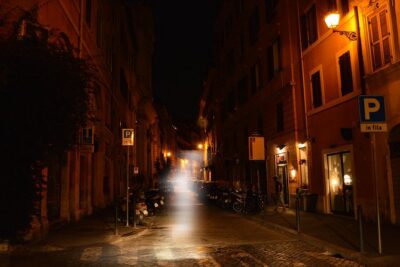
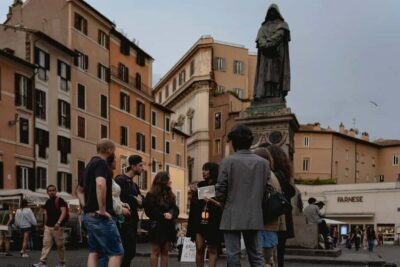
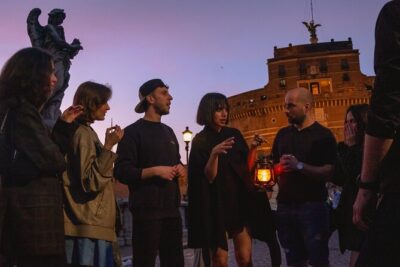

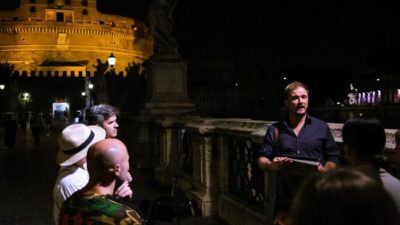
Small Group Rome’s Dark Side – Ghosts & Legends Tour
Read our review →
Ghosts, Legends & Mysteries of Rome Tip-Based Walking Tour
Read our review →
Browse the lists this tour appears in