
REVIEW · LONDON GHOST TOURS
London: Jack the Ripper Museum Tickets
Step into Victorian London’s darkest case. The Jack the Ripper Museum uses six floors of recreated rooms, police evidence, sound effects, and personal stories to explain the 1888 murders and the women caught in them. It is part history lesson, part theatrical crime scene, and part haunted-house experience.
I like the focus on the victims, not only the killer. I also like the recreated Whitechapel Police Station, with crime boards, letters, newspapers, and police equipment. The main caution is size: this is a small museum, and some people finish in about 45 minutes. If you read every panel and take your time, you can spend closer to 90 minutes.
Key Things to Know Before You Go
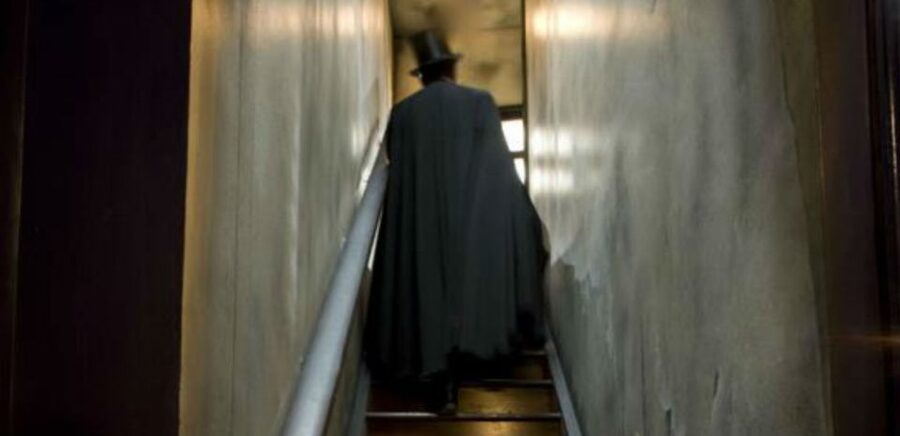
- Six floors tell the story in stages: You move from crime scenes and police work to the murderer’s room, the victims’ lives, and the morgue.
- Mitre Square is recreated in wax: You see a scene based on P. C. Watkins discovering Catherine Eddowes’s body.
- The victims receive real attention: The Mary Jane Kelly room includes domestic photographs, clothing, and details about the women’s difficult lives.
- The police room holds the strongest historical material: Look for the From Hell and Dear Boss letters, P. C. Watkins’s whistle, notebook, handcuffs, and truncheon.
- The tone is deliberately creepy: Sound effects, dim rooms, mannequins, and the morgue may be too intense for young children or sensitive visitors.
- The museum is easy to fit into an East London day: It is at 12 Cable Street, close to Tower Gateway, Tower Hill, and Aldgate East.
At 12 Cable Street, the Museum Begins Quietly
The museum is at 12 Cable Street in London’s East End. From the outside, the building can look more like an ordinary house than a major attraction, so keep your eyes open as you approach. Inside, the mood changes quickly.
Admission gives you access to the full museum for one day. This is not a guided walking tour through Whitechapel, and transport is not included. You make your own way to the entrance, then follow the museum’s route through the rooms.
The nearest stations are Tower Gateway, Tower Hill, and Aldgate East. That makes the museum fairly easy to add to a day around the Tower of London, the City, or East London. You do not need to set aside half a day. For most people, an hour is a sensible plan, with extra time if you enjoy reading displays closely.
The staff at the entrance can help you understand the best order for the rooms. A friendly welcome matters here because the museum is compact and the route is not the same as wandering through a large national museum.
More Jack the Ripper Tours in London:
- London: The Original Jack the Ripper Walking Tour
★ 4.7 · 7,833 reviews - London Jack the Ripper Guided Tour with Ripper-Vision
★ 4.5 · 4,840 reviews - London: Jack the Ripper Small Group Tour
★ 4.7 · 3,159 reviews
Six Floors and a Compact, Theatrical Layout
The museum packs its story into six floors. The rooms are designed to feel like period settings rather than neutral galleries. You will see wax figures, props, text panels, sound effects, and reconstructed interiors.
That approach works best if you enjoy atmosphere. The walls and room design help connect the separate parts of the story. A plain display of dates and names would be easier to overlook, but these rooms give you a sense of the investigation’s fear and confusion.
The tradeoff is that some displays can feel more theatrical than scholarly. This is not the place for a quiet, glass-case-only examination of Victorian crime. It aims to make the events immediate, sometimes uncomfortably so.
Take your time on the stairs and in each room. The museum is small, but it contains plenty of text. A quick pass gives you the basic story. A slower visit gives you more context about the police inquiry, the suspected killer, and the women who were murdered.
Mitre Square and the Discovery of Catherine Eddowes
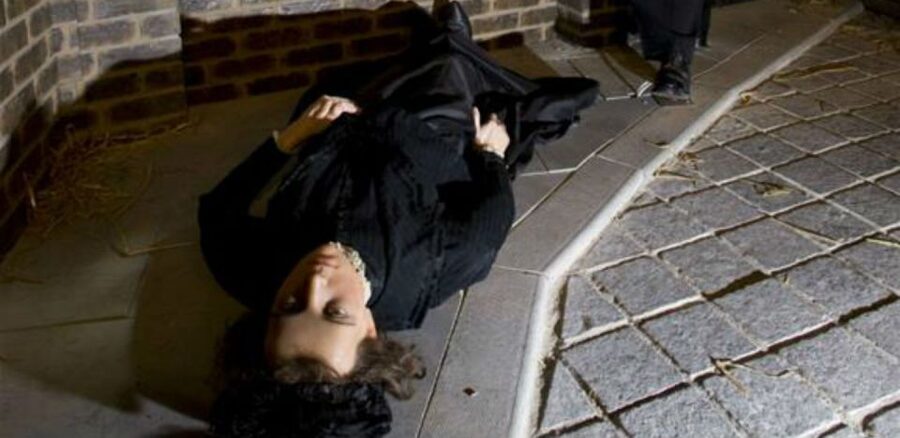
One of the first major scenes is a recreation of Mitre Square. A waxwork shows P. C. Watkins discovering the body of Catherine Eddowes.
This scene is designed to shock. The lighting, setting, and figure create an immediate sense of what a police officer might have faced in the early hours of the morning. It is one of the museum’s most direct displays, and it makes clear that the story is about real violence, not merely a puzzle for amateur detectives.
I find this room most useful when you pause to read the surrounding information rather than treating it as a quick photograph stop. The scene gives you a setting, while the written material explains the case and the investigation around it.
The museum does not hide the grim details. If you are uncomfortable with wax figures or murder scenes, you may want to move through this section quickly. The subject matter is graphic in tone even when the display is not a full reconstruction of every detail.
Jack the Ripper’s Sitting Room
After seeing a crime scene, you enter a recreation of Jack the Ripper’s sitting room. The room contains medical instruments, books, maps, letters, and Victorian objects linked to the case.
This is one of the more imaginative parts of the museum. The identity of Jack the Ripper remains unknown, so the room is a presentation of the suspect figure rather than a confirmed home belonging to a known man. That distinction matters. You are seeing an atmospheric interpretation of the case, not a proven personal interior.
A particularly unusual object is a drawing of a woman’s body on a metal bed, signed in red ink and associated with Walter Sickert, one of the names linked to Ripper theories. The display invites you to consider how evidence, rumor, and speculation have shaped the story over time.
I like this room because it shows how the legend grew. The case is not only about what happened in 1888. It is also about the objects, letters, theories, and images that kept the mystery alive.
Still, you should keep a critical eye. The museum presents the material in a dramatic setting, and not every theory surrounding Jack the Ripper is settled fact. Read the labels carefully and separate documented evidence from later speculation.
More Museum Visits in London:
- London: Jack The Ripper Walking Tour and Ripper Museum Entry
★ 4.1 · 17 reviews - Jack The Ripper Museum & See 30+ London Top Sights Tour
★ 4.2 · 4 reviews - Bundle: British Museum-Changing of the Guard-Jack the Ripper
★ 5.0 · 3 reviews - London’s Scariest Day Out : Walking Tour, Clink Prison & Jack The Ripper Museum
★ 5.0 · 2 reviews
Whitechapel Police Station and the Evidence Boards
The recreated Whitechapel Police Station is probably the strongest room for visitors who want investigation rather than horror. Whitechapel Police Station was central to the search, and the museum presents the case through crime boards, newspapers, police artifacts, and letters.
Look for the From Hell and Dear Boss letters. These documents are tied to the Ripper story and show how the case became a public sensation. Newspapers helped spread fear, while the letters added to the mystery and pressure on the police.
The room also displays a whistle associated with P. C. Watkins, along with his notebook, handcuffs, and truncheon. These objects help bring the police response down to a human scale. Instead of thinking only about an unknown killer, you begin to picture the officers who patrolled dark streets and had to respond to scenes of extreme violence.
This section rewards slow reading. The boards can feel crowded, especially if several people are trying to examine them at once. If you want the clearest understanding of the investigation, spend more time here than in the more theatrical rooms.
The museum presents these as major Ripper-related objects outside Scotland Yard’s private Crime Museum. That makes the police room an important part of the visit, even for someone who is less interested in horror displays.
Mary Jane Kelly’s Attic Room
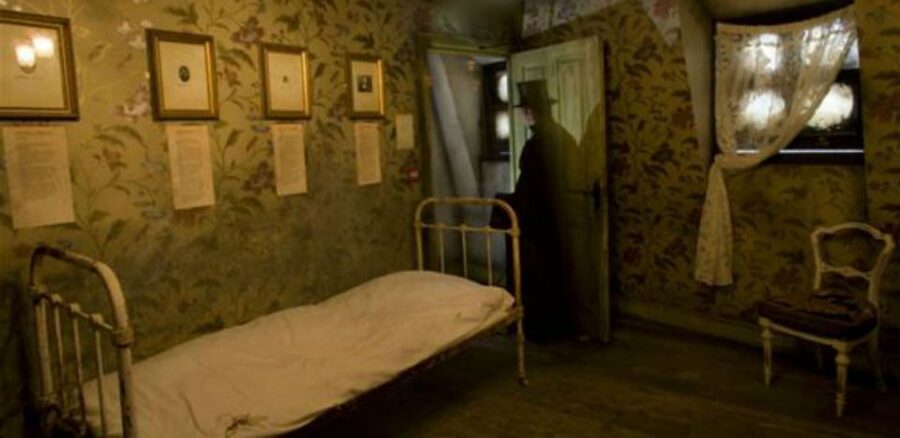
In the attic, you enter a recreation of Mary Jane Kelly’s bedroom. Her murder is described as the most horrific of the case, but this room’s power comes from something quieter: it shows how the women lived.
You will see a metal-framed bed with a straw mattress, boots, bonnets, domestic photographs, and other modest possessions. These details shift the mood away from the killer and toward the ordinary lives of poor Victorian East End women.
This is the room I would not rush. The personal items make the victims feel less like names in a crime story. Photographs of women and families remind you that each victim had relationships, routines, and a life outside the newspaper headlines.
Sound plays a role here too. A woman singing through a speaker creates a haunting effect in the attic. It is an unusual choice, but it works because the room is otherwise spare. The music gives the space a sad, human quality rather than relying only on shock.
The museum’s attention to the victims is one of its best decisions. Many Jack the Ripper attractions can become a celebration of the murderer’s fame. This room pushes back against that habit by showing the people who were harmed.
The Morgue and the Most Disturbing Displays
The final major section is the morgue. Here, you can study actual autopsy photographs and read reports about the nine women described as victims of the Ripper’s knife.
This is the point where you should decide how much you want to see. The photographs are not casual sightseeing material. They are disturbing documents connected to real deaths, and the museum presents them in a deliberately grim setting.
The morgue is valuable for visitors who want the starkest historical record. It removes some of the theatrical distance created by wax figures and reconstructed rooms. At the same time, it can feel too graphic for children and for anyone who prefers history presented without explicit images.
The museum does not require you to linger. You can move through this room at your own pace. If you are visiting with family, explain the tone before entering and be prepared to let younger children skip the photographs.
The two mannequins in the basement are another especially creepy detail. They add to the museum’s horror feel, but they are also a reminder that this attraction is designed to create an emotional reaction, not only provide dates and documents.
How Long to Allow and How to Pace Your Visit
Plan on about an hour as a practical starting point. A fast visit can take roughly 45 minutes. If you read the panels, examine the police evidence, and pause in the victims’ rooms, allow about 90 minutes.
There is no need to race from floor to floor. The museum is small enough that you can return your attention to details you missed earlier, but some rooms may feel close when several people are reading at once.
I would use this pacing:
- Spend a few minutes getting oriented at the entrance.
- Take your time with the Mitre Square recreation.
- Read the evidence boards and letters carefully.
- Pause in Mary Jane Kelly’s room to understand the victims’ lives.
- Treat the morgue as optional in depth, especially with children.
The self-guided format gives you control. You are not tied to a guide’s timetable, and you can linger over the subjects that interest you most. Some visits also include a guide or staff-led explanation. Names associated with especially well-received guide moments include Jasony and George, but the main experience is designed as a self-paced museum visit.
Atmosphere, Audio, and Historical Accuracy
Atmosphere is a major part of the ticket. You will encounter dark rooms, sound effects, wax figures, recreated interiors, and period-style settings. The audio in each room helps connect the spaces, with the attic singing often making the strongest impression.
The design can feel frightening, but it is not simply a horror attraction. The museum also gives you information about Victorian East London, police work, newspapers, social conditions, and the victims’ lives.
That balance is not perfect. The presentation sometimes leans hard into the spooky side, and the compact size means the museum cannot offer the same depth as a large archive or specialist research center. Yet for a short London visit, it gives you a clear introduction to the case and its public mythology.
I would treat the museum as a starting point rather than the final word on Jack the Ripper. It presents evidence and theories, but the case remains surrounded by uncertainty. The strongest reason to visit is not to solve the mystery. It is to understand how a series of murders affected Whitechapel and how the story became one of London’s most enduring crimes.
Is the $18.86 Ticket Good Value?
At about $18.86 per person, the ticket is fair if you enjoy true crime, Victorian London, or theatrical museums. The visit is short, so the value depends on your interests rather than the number of hours inside.
You are paying for a focused attraction with six floors, recreated rooms, displays, sound effects, and access to the full route. It is not the best choice if you measure value only by museum size. The building is compact, and some people will finish quickly.
I think the price makes more sense when combined with other nearby sights. You can pair it with the Tower of London area or a walk through the East End. Since transport is not included, factor in your own Underground or train fare.
The option to reserve now and pay later can help if your London schedule is still changing. Cancellation is free up to 24 hours in advance for a full refund, which gives you some flexibility. The museum is closed on Christmas Day.
A disabled person’s companion receives free admission. That policy is useful to know when planning the visit, though the provided information does not give further details about the building’s physical access.
Who Will Enjoy This Museum Most?
You are likely to enjoy the museum if you like:
- Jack the Ripper and unsolved crime stories
- Victorian London and East End social history
- Wax figures and recreated historical rooms
- Atmospheric, slightly frightening attractions
- Self-guided visits that let you read at your own speed
- Unusual museums that fit into a short afternoon
Families can enjoy it, and some children find the displays fascinating. But the murder scenes, autopsy photographs, and dark sound effects are not suitable for every child. I would use your own judgment rather than assuming the word museum means a gentle outing.
History-minded visitors should focus on the police room and the victims’ attic room. Horror fans will probably spend more time with the wax figures, basement displays, and morgue. You can get something different from the same ticket depending on how you pace the visit.
Should You Book the Jack the Ripper Museum?
Book it if you want a short, atmospheric look at the 1888 murders, especially if you are already visiting the Tower or East London. The strongest parts are the victim-focused Mary Jane Kelly room, the Whitechapel Police Station recreation, and the police artifacts.
Skip it if you dislike graphic crime material, want a large traditional museum, or expect a full guided tour of Whitechapel. The museum is compact, theatrical, and sometimes unsettling.
For the right audience, it is a well-priced stop with more historical detail than its spooky presentation first suggests. Go slowly, read the evidence, and keep the victims at the center of the story. That is where the experience has its greatest value.
FAQ
Where is the Jack the Ripper Museum?
The museum is at 12 Cable Street, London E1 8JG. The nearest Underground and train stations are Tower Gateway, Tower Hill, and Aldgate East.
How long is the museum visit?
The ticket is valid for one day. Many people complete the museum in about 45 minutes, while a slower visit with close reading can take around 90 minutes.
Is transportation included?
No. The ticket includes museum admission only. You must make your own way to 12 Cable Street.
What can I see inside the museum?
You can see recreated crime scenes, a Whitechapel Police Station, Jack the Ripper’s sitting room, Mary Jane Kelly’s bedroom, and a morgue with autopsy photographs and reports.
Is the museum suitable for children?
The museum includes murder scenes, disturbing images, wax figures, and frightening sound effects. Parents should decide based on the child’s sensitivity to graphic or scary material.
Is the museum open on Christmas Day?
No. The museum is closed on Christmas Day.
Can I cancel my booking?
Yes. You can cancel up to 24 hours in advance for a full refund. You can also reserve now and pay later.
Newly added around London
- Wicked Whitechapel: Where Now’s Jack The Ripper Audio Tour★ 5.0 · 2 reviews
- Ghosts, Gore & Other Ghasty Stories in the City of London★ 5.0 · 7 reviews
- Afternoon Jack the Ripper : Guided Tour★ 5.0 · 183 reviews
- Visit Jack the Ripper in French★ 5.0 · 33 reviews
- The Fading Light London Ghost Walk★ 5.0 · 35 reviews
- Self-Guided Audio Tour-Behind the shadow of evil: Jack the Ripper★ 4.0 · 2 reviews
- The Haunted Pubs of Old London: Small Group Tour★ 5.0 · 38 reviews
- Jack the Ripper – What About the Women?★ 5.0 · 39 reviews
London Ghost Tours, compared.
London Jack the Ripper Guided Tour with Ripper-Vision
Read our review →
Ghost, Ghouls and Gallows Tour : Guided Tour with Boat Ride
Read our review →
Jack the Ripper Tour with Immersive Ripper Vision
Read our review →
German Language : Original Jack the Ripper Tour
Read our review →Browse the lists this tour appears in