
REVIEW · LONDON GHOST TOURS
Jack the Ripper Private Immersive Tour
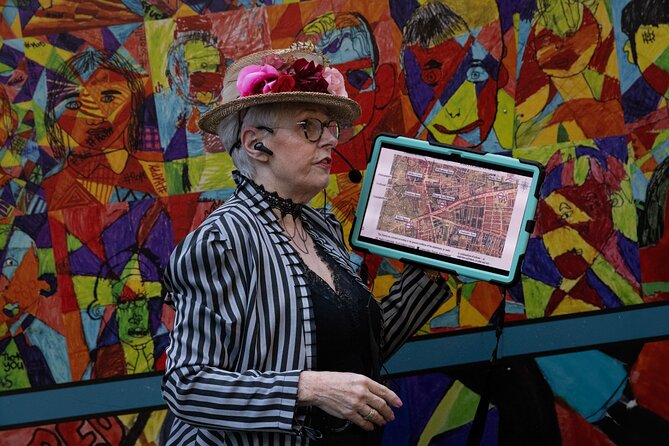
London’s darkest walk starts after sunset. I like the private guide, Jenny, who brings energy, clear opinions, and plenty of visual material to the story. I also like the route’s attention to ordinary life in 1888, including lodging houses, workhouses, hunger, street vendors, and the pressure that pushed vulnerable women into danger.
The main caution is the audio setup. Headphones are included, but one visitor had trouble hearing and received a guide using a microphone and speaker instead. You should also expect two and a half hours of walking and standing with no planned break, so this is not a gentle stroll.
Key points to know before you book
- The route covers 15 locations, from Aldgate Station to the area near Liverpool Street.
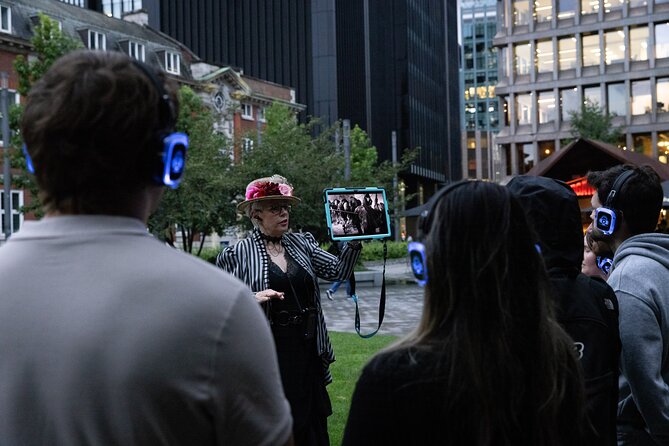
- Jenny leads the tour, using photographs, maps, crime details, and a personal theory about the killer.
- The route focuses on real streets and sites, not a museum or theatrical show.
- A 14-inch tablet helps with historic photographs, especially after dark.
- High-tech headphones are included, although the equipment has not worked equally well for everyone.
- The $47.52 price buys a private experience, but the value depends on your interest in true crime and your comfort with a long evening walk.
Starting at Aldgate with London in 1888
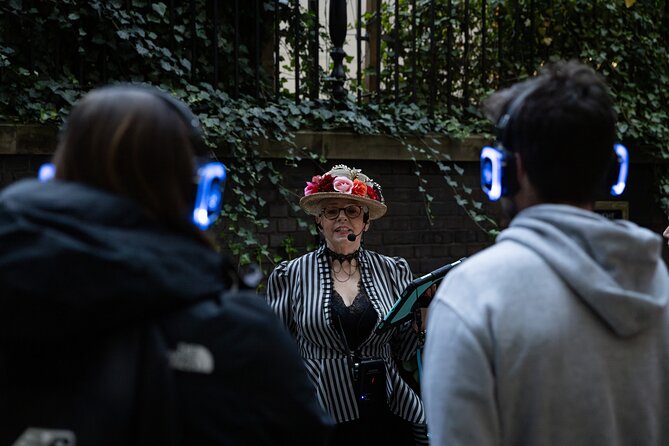
The meeting point is Aldgate Station, near the Dorsett City Hotel. This puts you close to the eastern edge of the City of London, where modern office towers quickly give way to the streets associated with Whitechapel and Spitalfields.
The opening six minutes provide a brisk introduction to the murders and the neighborhood as it existed in 1888. Do not expect a long historical lecture at the start. The guide gets you moving, then adds detail as the route unfolds.
At St Botolph’s Aldgate, the tour slows down to explain the conditions behind the headlines. You hear about homelessness, common lodging houses, workhouses, and the lack of steady employment. This is one of the strongest parts of the experience because it gives the murders a human setting instead of treating them as a puzzle detached from real lives.
The guide uses photographs on a 14-inch tablet. That matters after sunset, when a small printed image would be hard to see. You are shown what the area and its residents looked like, giving the discussion more weight than a string of spooky stories.
More Private Ghost Tours in London
- The Ultimate Jack the Ripper Tour (Private Group Booking)
★ 5.0 · 199 reviews - Private Tour of Haunted London in a Black Cab
★ 5.0 · 21 reviews - Jack the Ripper Private Day Time Walking Tour
★ 5.0 · 16 reviews
Mitre Street and the two murders in one night
The stop at Mitre Street deals with Elizabeth Stride and the events leading up to her death. You hear how Louis Diemschütz discovered her body near the gateway to Dutfield’s Yard, along with photographs of the victim and the location.
The strength here is the sense of sequence. Instead of simply hearing that Stride was killed, you follow the evening toward the discovery. The guide explains what was happening in the street and how the body was found in the early hours.
At Mitre Square, the subject shifts to Catherine Eddowes. Her body was found near the school gate, and the guide explains how PC Edmund Watkins discovered her while on his beat. The tour also follows the police search toward the clue found on Goulston Street.
This section is especially useful if you already know the basic case. It links the two murders and explains why the second discovery caused such excitement among the City of London Police. You get the geography, the timing, and the police response rather than only the gruesome details.
Goulston Street and the famous clue
At Goulston Street, the group stops opposite numbers 108 to 119 and looks toward the doorway connected with the case’s best-known clue. The guide explains what happened after the writing was found and why the Metropolitan Police and City of London Police did not operate as one unified force.
That police division is easy to miss in a general London history talk, but it helps explain the confusion around the investigation. The tour makes a point of showing how the two forces worked separately, a division that still exists today.
This is also where the experience shifts from crime scene detail to institutional history. You are not only asking who killed the women. You are also looking at how Victorian policing, jurisdiction, and public pressure shaped the search.
Wentworth Street and the question of the canonical five
At Wentworth Street, the guide returns to the beginning of the murder sequence and discusses a woman not traditionally included among the canonical five victims. The tour presents her as a likely victim based on the work of criminologist Professor David Wilson.
This is a useful stop for anyone who thinks the case begins and ends with the five names most often printed in books. The guide explains the murder, the later discussion around it, and why some researchers believe the accepted list may be too narrow.
Photographs of the site and victim support the presentation. The subject is grim, but the discussion also shows how the case continues to be reassessed. The tour does not pretend every point is settled.
More Private Ghost Tours in the UK
- Private Ghosts and Gore Walking Tour of London
★ 5.0 · 13 reviews - Dark History of the Tudors: Private Tour of Hampton Court Palace
★ 5.0 · 10 reviews - Private Jack the Ripper Walking Tour of Whitechapel and Brick Lane
★ 5.0 · 10 reviews - Jack the Ripper London Private Taxi Tour
★ 5.0 · 10 reviews
Brick Lane, Polly Nichols, and street life
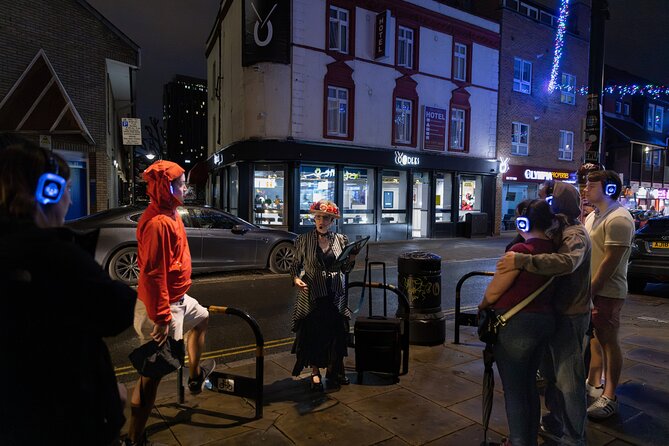
As you turn into Osborn Street and Brick Lane, the atmosphere changes. The tour adds period music, meant to suggest what you might have heard from pubs and music halls in 1888. This is a short sound effect, but it helps break up the spoken commentary.
Near the Frying Pan pub, the guide tells the story of Polly Nichols. The focus is not only on the murder. You hear how the need to find lodging money may have placed her in the street that night, along with the account of the men who found her body and sent for police.
That detail is important. It connects the crime to a daily struggle for a bed, a meal, and enough money to get through the night. The best parts of this tour repeatedly return to those practical pressures.
As you leave Polly Nichols behind, street vendors call out, recreating the noise of people selling goods. The guide also explains how police began questioning local residents about suspicious men. These short sound moments add variety, although your enjoyment will depend on how well you can hear the audio equipment in the street.
Hanbury Street and Annie Chapman’s final hours
Hanbury Street is one of the more detailed stops. Here you hear about Annie Chapman’s life, the events leading to her death, and her sighting less than an hour beforehand by Mrs Long.
The guide explains how Chapman was approached outside number 27 and taken into the backyard of number 29 with promises of money. The account then covers the murder, a prominent suspect who was later discounted, and photographs of the victim and site.
This stop is difficult material. The guide does not soften the brutality, so you should be comfortable with explicit crime discussion before booking. At the same time, the focus on Chapman as a person prevents the stop from becoming a mere horror story.
The short walk along Wilkes Street adds another layer. You hear how public anger was growing, how newspapers helped spread fear, and how some of the old houses date back to the 1700s. The guide explains who built them and why, linking the architecture to the people who lived and worked in the area.
Letters, newspaper noise, and the fear of Whitechapel
At Puma Court, the guide discusses one of the letters sent to the press during the investigation. More than a thousand letters were sent to police and newspapers, but only a small number continue to attract serious attention.
The stop also recreates the sound of newspaper sellers shouting lurid headlines. This is a good example of how the tour treats the murders as a public event. Fear did not spread only by word of mouth. It was sold on street corners, printed in large type, and repeated until the entire district felt watched.
Across from the Ten Bells on Commercial Street, the guide explains the area around Spitalfields Market and the pub associated with Mary Kelly. You also hear about Christchurch Graveyard and why it mattered to people without homes.
The discussion of small comforts is surprisingly effective. Items or spaces that seem ordinary today could have been valuable to someone sleeping rough, and competition over them could lead to arguments. This helps you understand the district through daily survival rather than through crime alone.
The guide also discusses how Jack the Ripper has caused controversy over the years. That gives the tour room to question popular stories rather than simply repeat them.
The Lusk letter and the final approach
At Brushfield Street, the group stands in the entranceway of the London Fruit and Wool Exchange building. The focus is the Lusk letter, which arrived in a box containing an item claimed to have come from one of the victims.
You see photographs of the letter and the recipient. This is one of the more recognizable pieces of evidence in the case, and the guide explains why it has continued to attract attention.
The presentation is visual and conversational. Jenny uses the tablet to show material that would be difficult to read or view on a phone in the dark. If you stand near the front, you should have a better chance of seeing the images and hearing the explanation.
The final stop is in the central courtyard of the London Fruit and Wool Exchange. It is the nearest point on the route to the room where Mary Kelly was killed. The guide describes Kelly as the youngest of the canonical victims and the only one killed indoors.
This final section lasts about 15 minutes and includes the events leading to her death, a graphic account of the murder, and discussion of suspects from the past and present. Jenny also gives her own theory about the killer and explains why she thinks it could fit the evidence.
The ending is practical. She directs you toward the shortest route to Liverpool Street Station, which is useful after a long evening on foot. You finish in a place with straightforward transport connections rather than being left to find your way through unfamiliar streets.
How the guide and equipment shape the night
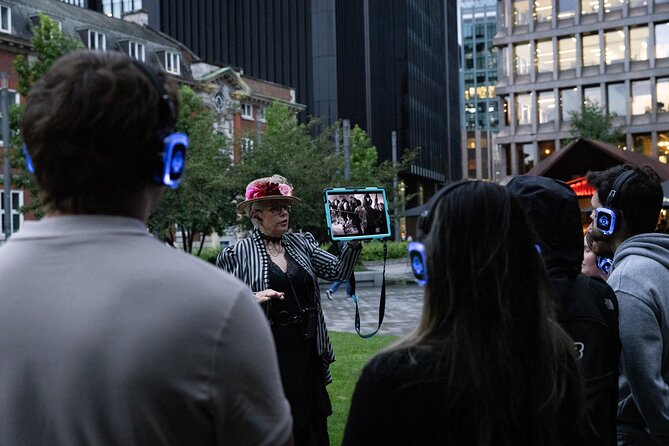
Jenny is the central reason this tour works. She is energetic, engaged, and willing to answer questions throughout the private walk. You are not restricted to a fixed script, so you can ask about suspects, police work, the victims, or the neighborhood.
Her use of photographs is one of the clearest strengths. The images help you compare the modern streets with the locations described in the case. They also make the talk easier to follow when the group is standing in a dark or busy area.
High-tech headphones are included in the advertised experience. When they work properly, they let you hear the guide while walking and make the sound effects more personal. One positive account specifically praised being able to stay connected to the commentary while moving between stops.
There is one important warning. On a particularly busy evening, the guide used a microphone and a speaker worn around the neck, and one person with hearing difficulty missed much of the talk. The guide said the sound cannot be turned up too far because local residents have complained about noise.
If you are hard of hearing, tell Jenny at the beginning and stand at the front. Also confirm before setting out exactly what audio equipment will be used. The tour details describe private headphones, but the actual arrangement may depend on group size and the evening’s conditions.
There was also some confusion involving the word immersive in the booking information. A different version of the experience was described in an automated confirmation, even though it was not the same public walk. Check your confirmation carefully so you know which format you have purchased.
Is $47.52 good value?
At $47.52 per person, this is not the cheapest way to spend an evening in East London. You are paying for a private guide, a long route, photographs, audio equipment, and a focused presentation rather than a quick 60-minute walk.
For a true crime fan, the price is reasonable because the tour combines the main murder sites with the social conditions behind them. You get much more than a list of victims and suspects. You also get police jurisdiction, newspaper culture, homelessness, historic buildings, and the way the case shaped public fear.
The value is weaker if you have only a passing interest in Jack the Ripper. Two and a half hours is a long time to spend on one case, especially when the material becomes graphic and the route includes extended standing.
There is no bottled water included, so bring your own. Wear shoes you can walk in and dress for the weather. The tour requires good weather and may be moved or refunded if conditions are poor.
Free cancellation is available up to 24 hours before the start time. Changes or cancellations inside that window are not accepted for a refund. The tour may also be canceled if the minimum number of participants is not met.
Who will enjoy this private London walk?
I would recommend it to:
- People who already know the basic Jack the Ripper case and want the streets, evidence, and competing theories.
- True crime fans who enjoy detailed and graphic historical discussion.
- Visitors who prefer a private guide and the chance to ask unlimited questions.
- London residents looking for a different way to see Aldgate, Whitechapel, Brick Lane, and Spitalfields.
- Anyone interested in Victorian poverty, policing, newspapers, and urban life.
I would hesitate to recommend it to anyone with walking or standing difficulties. The route lasts about 2 hours and 30 minutes with no break, and the pace includes many stops on city streets.
It is also not ideal for young children or anyone uncomfortable with explicit descriptions of murder. The tone is serious, although period sounds, photographs, and the guide’s personality keep it from becoming a flat lecture.
Should you book the Jack the Ripper private tour?
Book it if you want a serious, street-level look at the case and you value a guide who will discuss evidence, uncertainty, and her own theory. Jenny’s energy, visual material, and willingness to answer questions are the best reasons to choose it.
Skip it if you want a short, light London attraction, guaranteed silent headphones, or a route with places to sit and rest. Before paying, confirm the audio arrangement and the exact tour format shown in your booking email.
For the right audience, this is a thoughtful and atmospheric way to see a less polished side of London. Just remember that the real subject is not only the killer. It is also the poverty, housing crisis, policing failures, and public fear that shaped Whitechapel in 1888.
FAQ
Where does the Jack the Ripper tour start?
The tour starts at Aldgate Station in London, near the Dorsett City Hotel.
Where does the tour finish?
It finishes at Bell Lane, near the London Fruit and Wool Exchange. The guide also directs you toward the shortest route to Liverpool Street Station.
How long does the tour last?
The tour takes approximately 2 hours and 30 minutes.
Is this a private tour?
Yes. Only your group participates in the private activity.
Are headphones included?
High-tech headphones are listed as included. However, the audio arrangement may vary, so confirm the equipment before beginning, especially if you have hearing difficulty.
Is the tour suitable for people with walking difficulties?
It is not recommended for people with walking or standing difficulties because it lasts about two and a half hours with no break.
Can I cancel for a refund?
You can cancel at least 24 hours before the start time for a full refund. Cancellations or changes made less than 24 hours in advance are not accepted for a refund.
More Jack the Ripper Tours in London
- London: The Original Jack the Ripper Walking Tour
★ 4.7 · 7,833 reviews - London Jack the Ripper Guided Tour with Ripper-Vision
★ 4.5 · 4,840 reviews - London: Jack the Ripper Small Group Tour
★ 4.7 · 3,159 reviews - London Jack The Ripper Guided Walking Tour
★ 5.0 · 3,131 reviews
Newly added around London
- Wicked Whitechapel: Where Now’s Jack The Ripper Audio Tour★ 5.0 · 2 reviews
- Ghosts, Gore & Other Ghasty Stories in the City of London★ 5.0 · 7 reviews
- Afternoon Jack the Ripper : Guided Tour★ 5.0 · 183 reviews
- Visit Jack the Ripper in French★ 5.0 · 33 reviews
- The Haunted Pubs of Old London: Small Group Tour★ 5.0 · 38 reviews
- The Fading Light London Ghost Walk★ 5.0 · 35 reviews
- Self-Guided Audio Tour-Behind the shadow of evil: Jack the Ripper★ 4.0 · 2 reviews
- Jack the Ripper – What About the Women?★ 5.0 · 39 reviews
London Ghost Tours, compared.
London Jack the Ripper Guided Tour with Ripper-Vision
Read our review →
Ghost, Ghouls and Gallows Tour : Guided Tour with Boat Ride
Read our review →
Jack the Ripper Tour with Immersive Ripper Vision
Read our review →
German Language : Original Jack the Ripper Tour
Read our review →Browse the lists this tour appears in